On June 18, 2021, Nicole Tratnik presented a talk on the effect of amylose and amylopectin content on epoxidation and adhesion properties at the 25th Annual ACS Green Chemistry and Engineering Conference.
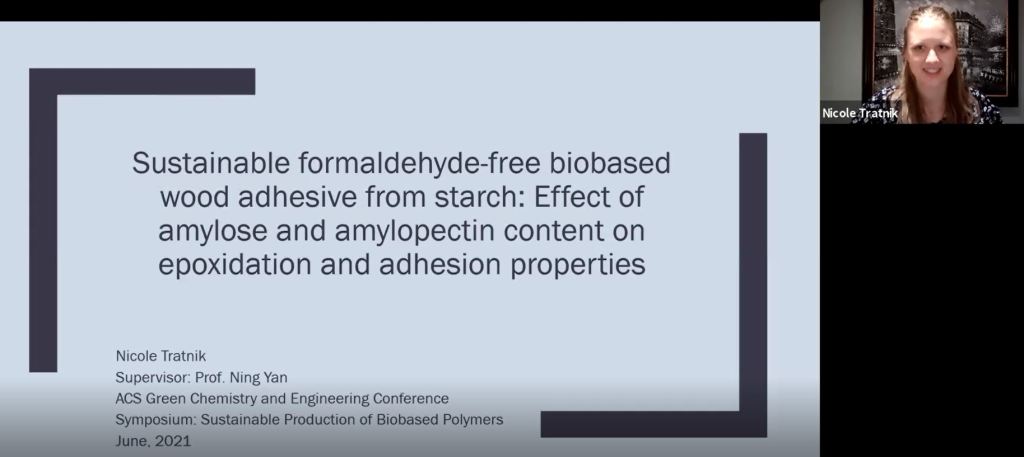

On June 18, 2021, Nicole Tratnik presented a talk on the effect of amylose and amylopectin content on epoxidation and adhesion properties at the 25th Annual ACS Green Chemistry and Engineering Conference.

This year Professor Ning Yan was selected as the recipient of the 2021 Bill Burgess Teacher of the Year Award for Small Classes by the Department’s Teaching Effectiveness Committee. This award aims to recognize the efforts and excellence in teaching within ChemEng.
The award was announced during the virtual awards celebration Friday April 9, 2021.The plaque for this award lives on the second floor of the Wallberg Building where Professor Ning Yan’s name will be added.
Artwork by Dr. Nicolas R. Tanguy was featured in ChemSusChem for the article written by Dr. Nicolas R. Tanguy, Dr. Haoran Wu, Dr. Sandeep S. Nair, Prof. Keryn Lian, and Prof. Ning Yan. Read the article here
This article was was also covered in the ChemViews Magazine.

Professor Ning Yan has been elected Fellow of the Engineering Institute of Canada for her contributions to engineering and service to the profession and society.
Click here for the full article in University of Toronto Engineering News
A new article out of Prof. Ning Yan’s lab in collaboration with Prof. Lian’s lab (Materials Engineering) has been published in Chemistry Europe’s ChemSusChem written by Dr. Nicolas Tanguy, Dr. Haoran Wu, Dr. Sandeep Niar, Prof. Keryn Lian and Prof. Ning Yan. This article explores using lignin cellulose nanofibrils in fabricating flexible supercapacitor electrodes for wearable electronics.The article was selected as Very Important Paper by the Editors of the journal, invited for an article in Chemistryviews.org, and for a Cover art as well. More to come!
Click here to view the article
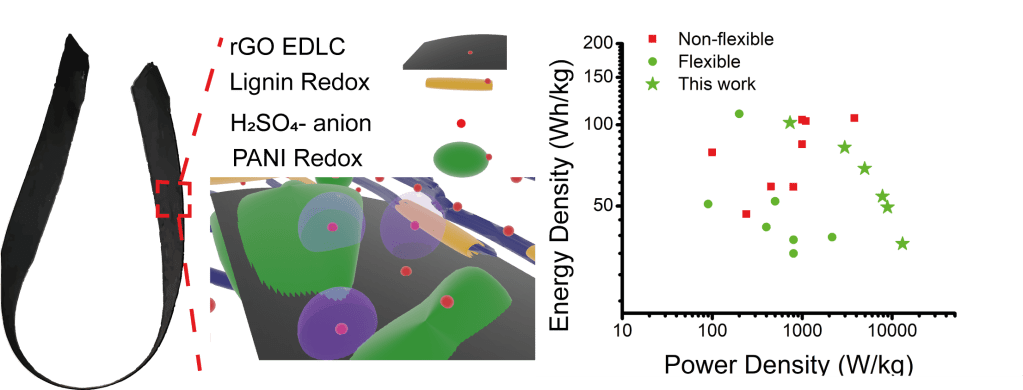
The increasing demand for wearable electronics has driven the development of supercapacitor electrode materials toward enhanced energy density, while being mechanically strong, flexible, as well as environmentally friendly and low‐cost. Taking advantage of faradaic reaction of quinone groups in natural lignin that is covalently bound to the high‐strength cellulose nanofibrils, the fabrication of a novel class of mechanically strong and flexible thin film electrodes with high energy storage performance is reported. The electrodes were made by growing polyaniline (PANI) on flexible films composed of lignin‐containing cellulose nanofibrils (LCNF) and reduced graphene oxide (rGO) nanosheets at various loading levels. The highest specific capacitance was observed for the LCNF/rGO/PANI electrode with 20 wt% rGO nanosheets (475 F g−1 at 10 mV s−1 and 733 F g−1 at 1 mV s−1), which represented a 68 % improvement as compared to a similar electrode made without lignin. In addition, the LCNF/rGO(20)/PANI electrode demonstrated high rate performance and cycle life (87 % after 5000 cycles). These results indicated that LCNF functioned as an electrochemically active multifunctional component to impart the composite electrode with mechanical strength and flexibility and enhanced overall energy storage performance. LCNF/rGO(20)/PANI electrode was further integrated in a flexible supercapacitor device, revealing the excellent promise of LCNF for fabrication of advanced flexible electrodes with reduced cost and environmental footprint and enhanced mechanical and energy storage performances.
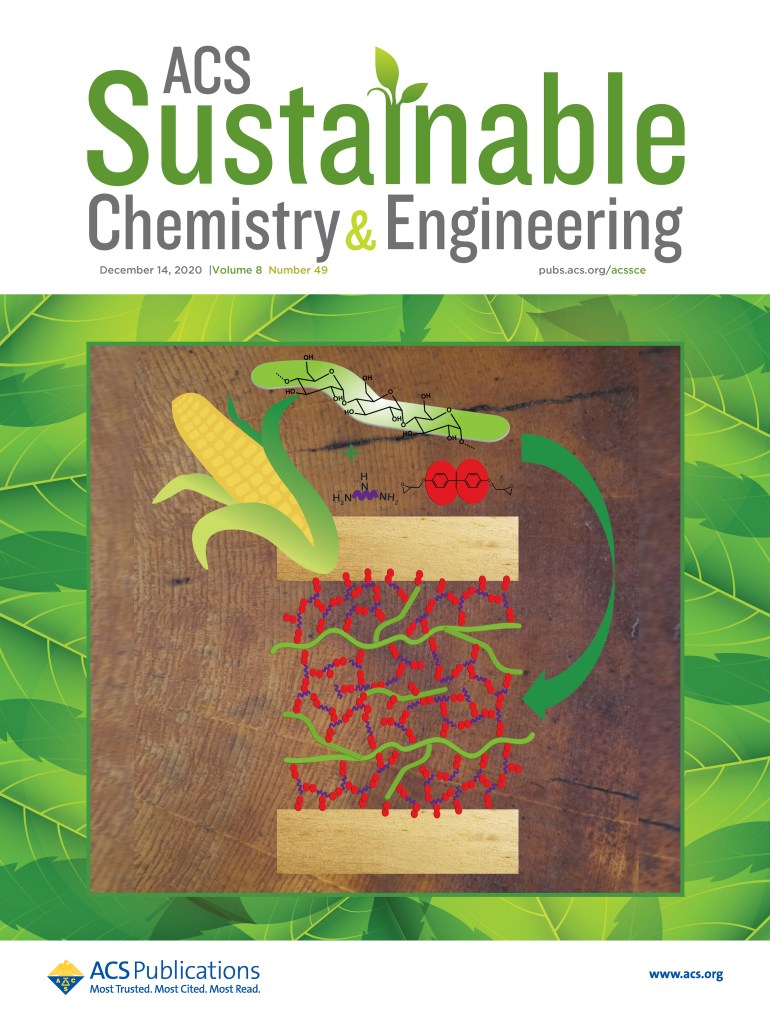
The supplimentary cover art by Nicole Tratnik, from the article “Biobased Epoxidized Starch Wood Adhesives: Effect of Amylopectin and Amylose Content on Adhesion Properties”(10.1021/acssuschemeng.0c05716) was recently published in ACS Sustainable Chemistry & Engineering.
Click here to see the article
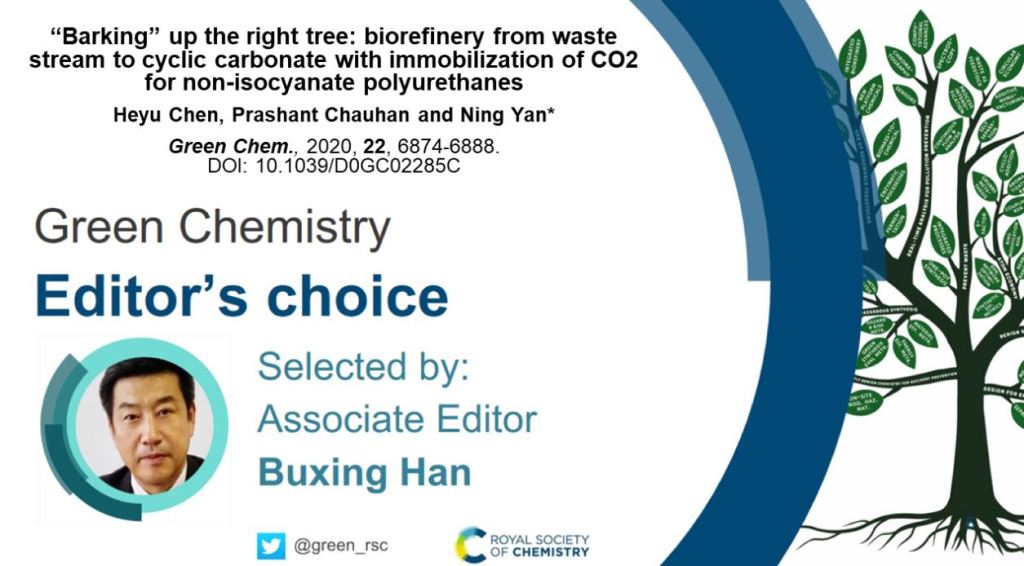
The article Barking up the right tree: biorefinery from waste stream to cyclic carbonate with immobilization of CO2 for non-isocyanate polyurethanes by Heyu Chen, Prashant Chauhan and Ning Yan has been selected by editor Buxing Han to be highlighted as a Green Chemistry Editor’s Choice.
The blog post showcasing the publication can be found here and is publically accessible until Feb 2021.
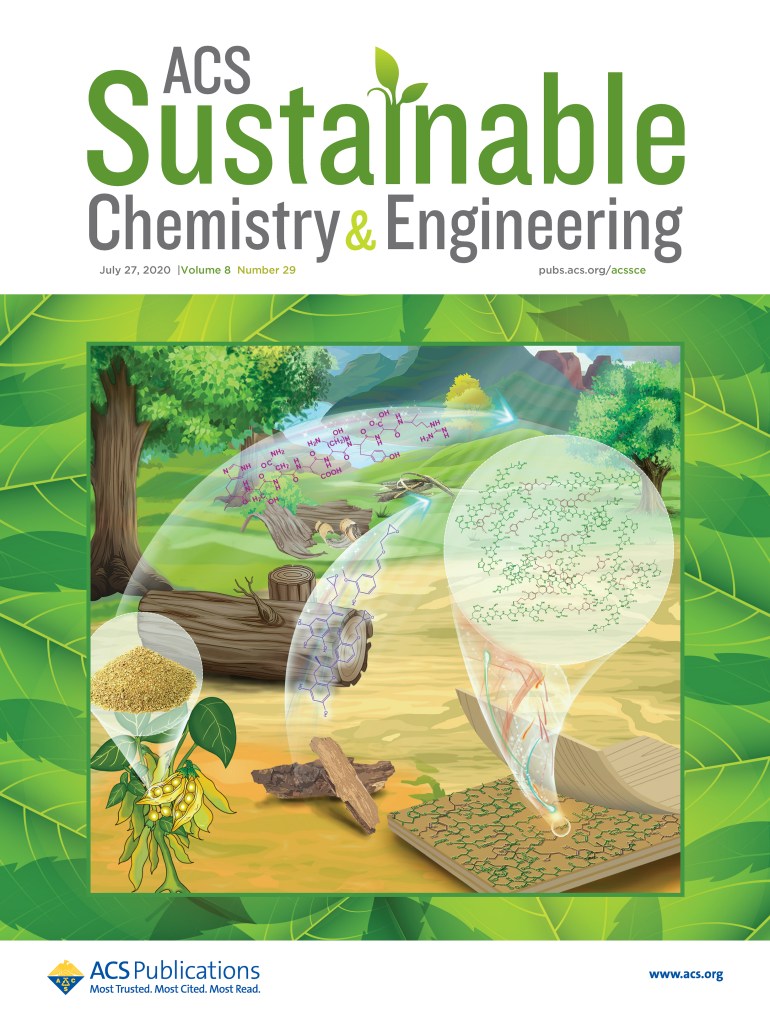
The supplimentary cover art by Luojing, from the article “From Wastes to Functions: A New Soybean Meal and Bark-Based”(10.1021/acssuschemeng.0c02413) was recently published in ACS Sustainable Chemistry & Engineering.
Click here to see the article
Last Tuesday June, 2, 2020, Heyu Chen celebrated his convocation online along with many others. We would like to congratulate him on this achievement. We are proud of you Heyu!

Advances in Engineering—which recognizes important findings in engineering fields and reports timely engineering research news—has recently labeled a research work that came from Professor Ning Yan’s group as a “key scientific article contributing to science and engineering research excellence.”

This work was done by University of Toronto researchers: Heyu Chen (PhD candidate), Dr. Sandeep Nair, Dr. Prashant Chauhan and led by distinguished professor, Prof. Ning Yan; they investigated the effect of lignin-containing nanocellulose (LCNF) on the reinforcing performance of pMDI wood adhesives. As concluded by Advances in Engineering: “Sustainable LCNF from renewable biomass will advance the development of high-performance pMDI adhesives for wider practical applications.”
For further information, this work is published in Chemical Engineering Journal.
Chen, H., Nair, S., Chauhan, P., & Yan, N. (2019). Lignin containing cellulose nanofibril application in pMDI wood adhesives for drastically improved gap-filling properties with robust bonding line interfaces. Chemical Engineering Journal, 360, 393-401.
 Yan Lab