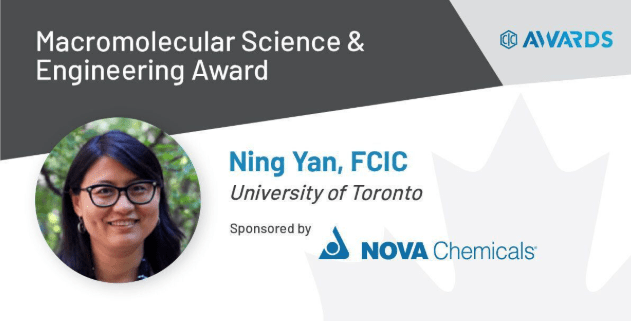
This distinguished honor is presented to an individual residing in Canada who has made an outstanding contribution to the advancement of macromolecular science or engineering. Professor Yan’s innovative research, leadership, and dedication to the field exemplify the spirit of this award and highlight the remarkable impact of their work on both the scientific community and the next generation of researchers. Our group is proud to celebrate this well‑deserved recognition. Link to page: Macromolecular Science and Engineering Award
A new article from Ning Yan’s lab has been published in the Chemical Engineering Journal written by Cheng Hao, Daniel Davidson, Haonan Zhang, Alper Alper, Shawn Prevoir and Ning Yan.
The flammability of polycarbonate/acrylonitrile butadiene styrene (PC/ABS) significantly restricts its use in safety-critical applications, despite its desirable mechanical and thermal properties. Bio-based, halogen- and PFAS-free flame retardants have gained interest as sustainable alternatives to conventional halogen-based flame retardants for engineering thermoplastics, yet most exhibit insufficient thermal stability for the demanding processing temperatures (>250 °C) required by high melting point engineering thermoplastics, such as PC/ABS. To overcome this fundamental thermal stability bottleneck, in this study, a reactive compatibilization strategy was developed to tailor a thermally robust and compatibilized lignin-derived flame-retardant system for PC/ABS. Nitrogen and phosphorous modified lignin was pre-compounded with styrene-maleic anhydride copolymer (SMA), which not only significantly raised the onset decomposition temperature (Td5 = 293 °C) to withstand the high-temperature compounding, but also ensured uniform dispersion within PC/ABS. This strategy enabled, to the best of our knowledge, for the first time, effective incorporation of a bio-based flame retardant into engineering-grade PC/ABS at industrial relevant loadings. With the addition of 5 wt% LNP and 10 wt% SMA, the PC/ABS blends achieved the UL-94 V-0 rating with an increased limited oxygen index (LOI) and a 51.5 % reduction in peak heat release rate, while significantly enhancing heat deflection temperature and maintaining tensile strength of the PC/ABS samples. Mechanistic investigations revealed a synergistic condensed-phase barrier effect from crosslinked phosphorus-rich char and a gas-phase radical-quenching effect to suppress flame propagation. This work aligns with current regulatory drivers to replace halogenated and PFAS-based additives, showing a viable pathway for developing sustainable and high-performance flame retardants for engineering thermoplastics with high melting temperatures.
A new article from Ning Yan’s lab has been published in the Chemical Engineering Journal written by Mohammad H. Mahaninia, Keerti Rathi, Ning Yan, Mohini Sain, Colin van der Kuur.
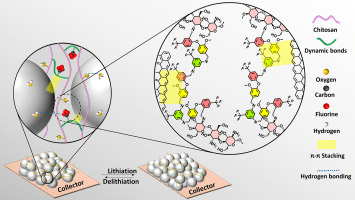
To enhance the performance and durability of lithium-ion batteries, the development of effective binder materials in the anode is crucial, with eco-friendliness being an additional consideration. This study presents a bio-based and self-healable polymeric binder designed for use in graphite-based anodes to achieve enhanced battery performance. The binder was synthesized via a Schiff base reaction between chitosan and a vanillin-derived linker, forming imine bonds that establish a self-healable 3D network. The bio-based binder effectively holds the graphite particles together while also providing excellent mechanical strength, thermal stability, and strong adhesion to the copper foil. Notably, it demonstrated self-healing behavior, with mechanical recovery exceeding 90 % after damage. Thermogravimetric analysis confirmed high thermal stability up to 300 °C, while the binder exhibited excellent tensile adhesion strength (ca. 21 kPa). Both coin and pouch cells fabricated with the bio-based binder achieved a specific capacity of 161.2 mAh g−1 and retained 81 % of their capacity after 250 cycles. Coulombic efficiency remained consistent at above 92 % even after 250 cycles, indicating no side reactions. Even at a high current density of 1.0C, the cells maintained approximately 50 % of their original capacity measured at 0.3C, showcasing excellent rate capability. Electrochemical impedance spectroscopy revealed low interfacial resistance, further validating the stability of the chitosan-based binder. We anticipate that this class of bio-based binders will not only extend the service life of lithium-ion batteries but also make a significant contribution to greener, safer energy storage technologies.
A new article from Ning Yan’s lab has been published in the Journal of Cleaner Production written by Kaiwen Chen, Cheng Hao, Luyao Chen, Fengze Sun, Yujing Tan, Wenjuan Zhao, Hui Peng, Tianyi Zhan, Jianxiong Lyu and Ning Yan.
Wood-based membranes offer a promising, sustainable platform for oil/water separation due to their intrinsic porosity, renewability, and structural anisotropy. However, current approaches often require complex chemical modifications and lack a systematic understanding of how structural and processing parameters govern separation performance. This study introduced a simple yet robust strategy leveraging intrinsic structural anisotropy of natural wood to fabricate high-performance membranes without synthetic coating or surface functionalization. By altering the cutting direction, two distinct membrane architectures were obtained: cross-section membranes with longitudinal channels enabled the gravity-driven separation of light oil/water mixtures, while longitudinal membranes with interconnected transverse pores facilitated vacuum-assisted separation of oil-in-water emulsions. Quantitative analysis revealed that delignification time and thickness jointly governed wetting and transport behavior. Increasing delignification reduced the water contact angle from ∼115° to <40°, enabling tunable flux (∼90–1000 L m−2·h−1) and efficiency (75–99.9 %). For CW membranes, flux decreased and efficiency increased with thickness—thinner samples (0.5–1 mm) exhibited the highest flux (∼995 L m−2·h−1) but moderate efficiency (85–95 %), while thicker ones (∼3 mm) achieved up to 99.8 % efficiency at lower flux. For LW membranes, a similar trade-off was observed: thinner membranes (0.5–1 mm) offered higher flux (75–95.9 % efficiency), intermediate thickness (1–2 mm) balanced both (up to 99.1 %), and thicker membranes (∼3 mm) provided the highest efficiency (98.9–99.9 %) but reduced flux. Through systematic characterization, this study established a clear structure–property–performance relationship, revealing how processing parameters (cutting orientation, thickness, and lignin content) govern key structural features and, in turn, separation efficiency and flux. This work not only provides a sustainable route for fabricating high-performance membranes using natural materials but also delivers quantitative mechanistic insights and predictive design principles for liquid–liquid separation, with broad relevance for environmental remediation and resource recovery.
We are excited to share that our recent paper, “Biobased Bionic Spider Silk via Electrostatic Complexation for Simultaneously Harvesting Atmospheric Water and Triboelectric Energy”, has been featured in the Nanowerk Spotlight series!
A new article from Ning Yan’s lab has been published in the Advanced Functional Materials written by Qin Chen, Araz Rajabi-Abhari, Tongtong Fu, Haonan Zhang, Siqi Huan, Liang Chen, Jinchao Li, Cheng Hao, Yaping Zhang and Ning Yan
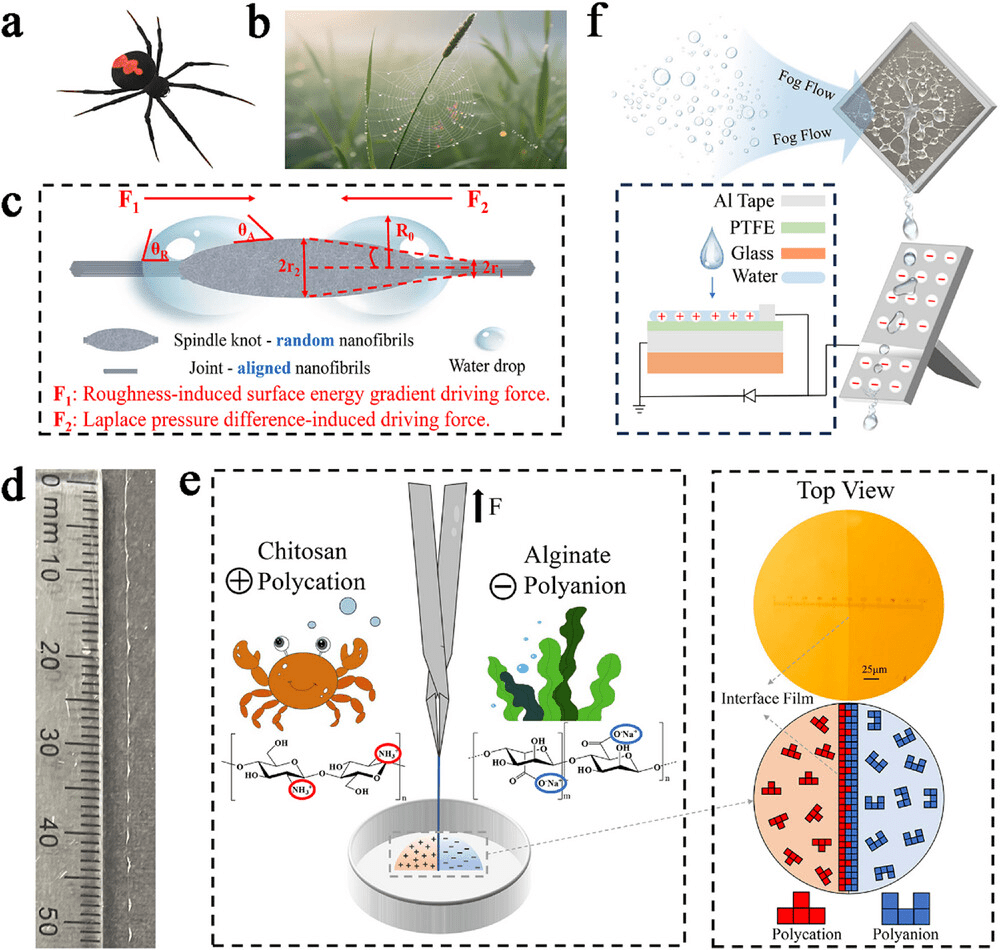
Atmospheric water harvesting has emerged as a sustainable solution for overcoming water and energy shortages. Herein, an entirely biobased bionic spider silk (chitosan–sodium alginate filament [CSF]) is prepared using an interfacial, aqueous, and straightforward polyelectrolyte complexation with a continuous drawing technique, simultaneously harvesting water and triboelectric energy from ambient humidity. CSF exhibits a periodic spindle-shaped structure resembling spider silk, with surface roughness conducive to atmospheric water harvesting. The success of the electrostatic complexation technique for CSF is confirmed by water solubility, Fourier-transform infrared spectroscopy, and thermogravimetric analyses. The production yield of CSF reaches the maximum of 99.36% by controlling the substrate type and polyelectrolyte mass ratio. Moreover, fog-harvesting efficiency peaks at 1552.83 mg cm−1 h−1 (1.0 wt.% polyelectrolyte concentration), demonstrating concentration-dependent performance. Subsequently, CSF is woven into a bionic spider web (CSW) for simultaneous water and energy harvesting. Through parametric optimization, the CSW-based droplet triboelectric nanogenerator system achieves 180 V and 72.25 µW output. When deployed in a high-humidity greenhouse, the system powers 80 light-emitting diodes, a hygrometer (thermometer), and a stopwatch. This study presents a straightforward, effective, and green strategy for simultaneously harvesting water and energy from the ambient environment, providing fresh water and renewable energy to enhance sustainability.
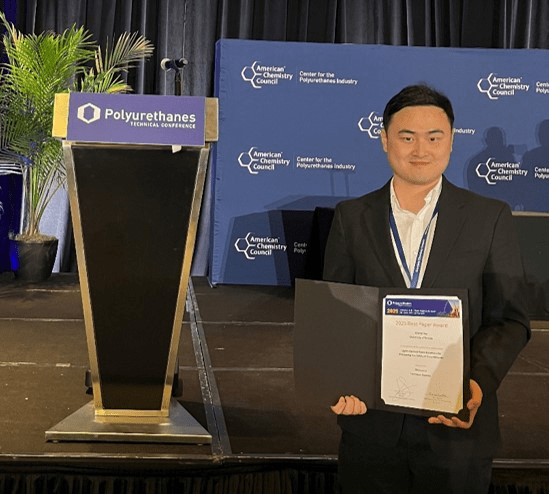
We are thrilled to share that our very own post-doctoral fellow, Dr. Cheng Hao, has received the Best Paper Award at the 2025 Polyurethanes Technical Conference (PolyCon 2025).
Cheng’s presentation, “Lignin-Derived Flame Retardant for Enhancing Fire Safety of Polyurethanes,” was recognized for its innovation and industrial relevance among professionals from across the globe. Congratulations, Cheng!
We’re raising a coffee cup (and a slice of cake) to Nicole!
After an amazing nine years in our lab at U of T, Nicole is moving on. It’s hard to imagine the lab without her, but we’re thrilled to see her take this next step.
Nicole joined us back in 2016 and has been a key part of the team ever since, completing her Master’s, PhD, and a Post-doc all with our group. We’ve been so lucky to have her as a colleague.
The industry is lucky to get her. We wish her the best of luck!
Last week, a member of Prof. Ning Yan’s Lab, Gaojian Guo, successfully passed his qualifying exam signifying she is able to continue with his PhD studies. In the next few years he will continue his work on studies in the high-value utilization of lignin and its functional applications.
Last week, a member of Prof. Ning Yan’s Lab, Lavia Li, successfully passed her qualifying exam signifying she is able to continue with her PhD studies. In the next few years she will continue her work on the studies on engineering strategies of graphite in next generation battery.





 Yan Lab