New Article: A new 3D printing strategy by enhancing shear-induced alignment of gelled nanomaterial inks resulting in stronger and ductile cellulose films

A new article out of a collaboration between Professor Ning Yan and Dr. Dan Li has been published in the Carbohydrate Polymers Journal written by Yunxia Yang, Dan Li, Ning Yan and Fu Guo.

You can find the article here

Abstract

Cellulose nanofibrils (CNFs) are derived from biomass and have significant potential as fossil-based plastic alternatives used in disposable electronics. Controlling the nanostructure of fibrils is the key to obtaining strong mechanical properties and high optical transparency. Vacuum filtration is usually used to prepare the CNFs film in the literature; however, such a process cannot control the structure of the CNFs film, which limits the transparency and mechanical strength of the film. Here, direct ink writing (DIW), a pressure-controlled extrusion process, is proposed to fabricate the CNFs film, which can significantly harness the alignment of fibrils by exerting shear stress force on the filaments. The printed films by DIW have a compact structure, and the degree of fibril alignment quantified by the small angle X-ray diffraction (SAXS) increases by 24 % compared to the vacuum filtration process. Such a process favors the establishment of the chemical bond (or interaction) between molecules, therefore leading to considerably high tensile strength (245 ± 8 MPa), elongation at break (2.2 ± 0.5 %), and good transparency. Thus, proposed DIW provides a new strategy for fabricating aligned CNFs films in a controlled manner with tunable macroscale properties. Moreover, this work provides theoretical guidance for employing CNFs as structural and reinforcing materials to design disposable electronics.

Welcoming a new addition

Today we’d like to welcome the newest future scientist in the world, our PhD candidate Kabirat’s new son Rayyan.

Congratulations to Kabirat and her family! We are happy to see your family grow. 🥰

New Article: Degradable and Biobased Covalent Adaptable Networks for Light Controllable Switch

A new article out of a collaboration between Dr. Ning Yan and Dr. Jing Chen’s labs has been published in the ACS Sustainable Chemistry & Engineering written by Xiaozhen Ma, Xiaolin Wang, Honglong Zhao, Minghui Cui, Xiaobo Xu, Fangfang Kong, Peng Chen, Ning Yan, Jin Zhu and Jing Chen.

You can find the article here

Abstract

In this study, we successfully synthesized lignin-based covalent adaptable polyurethane networks containing lignin-graphite nanosheet composite particles with a light controllable positive temperature coefficient (LPTC) effect. The use of lignin facilitated the direct exfoliation of graphite, thus overcoming the challenge of achieving a uniform dispersion of conductive fillers in the polymer matrix. The exfoliated graphite had a thickness of approximately 3.0 nm, which was equivalent to three to five layers of graphene. By preparing lignin-based covalent adaptable polyurethane without graphite composite particles (LPU) and lignin-based covalent adaptable polyurethane with graphite composite particles (LPU-G), we achieved remoldable properties and a high LPTC intensity for LPU-G. LPU-60G (60 represents the mass fraction of lignin-graphite nanosheets in polyols) exhibited an excellent LPTC effect, with sharp increases in resistance under light, particularly under near-infrared light (NIR), enabling the control of the current in circuits. Additionally, both LPU and LPU-G demonstrated degradability by slowly degrading in a PBS solution while rapidly degrading in an alkaline solution. Overall, the LPU-G synthesized in this study displayed superior stability in the LPTC effect and possessed degradability, providing a promising avenue for the future development of smart materials.

New Article: Robust and ultra-tough lignocellulosic organogel with zipper-like sliding noncovalent nanostructural design: Towards next-generation bio-derived flexible electronics

A new article from Ning Yan’s lab has been published in Chemical Engineering Journal written by Haonan Zhang, Yanchen Zhu, Tongtong Fu, Cheng Hao, Yang Huang, Hao Ren, Ning Yan, Huamin Zhai. You can find the article HERE.

Click here to see the full article until April 25, 2024

Abstract

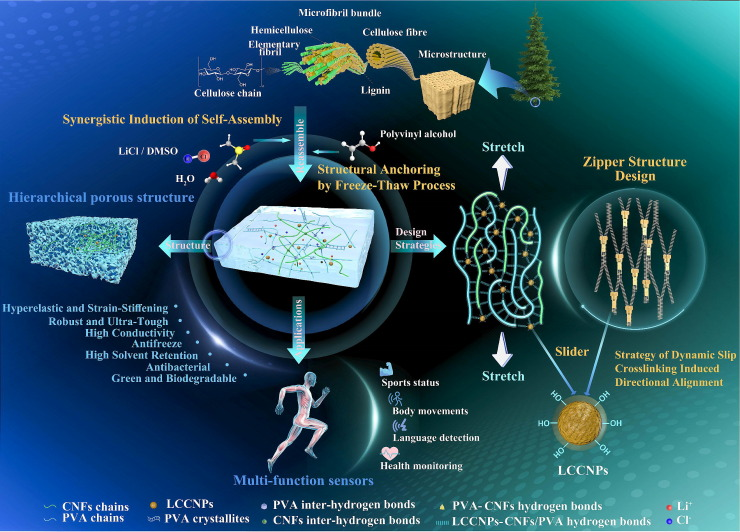
Soft electronics have garnered significant interests owing to their distinctive qualities. However, their practical utilizations are still limited by their generally poor mechanical properties, environmental concerns, and incompatibility. Here, we present a unique hierarchical nanoarchitectural design of dynamic noncovalent supramolecular zipper to achieve synergistic enhancement of both mechanical strength and toughness in organogels. By building lignin-carbohydrate complexes nanoparticles (LCCNPs)-based sliding zippers within the interpenetrating polymer networks (IPN) formed by in-situ regenerated cellulose nanofibrils (CNFs) and polyvinyl alcohol (PVA) molecular chains, the lignocellulosic organogels demonstrated excellent mechanical properties, shape recovery performances, and strain-stiffening behaviors. The ultimate tensile strength increased by 11-fold, reaching 8.29 MPa, while the toughness also had an increase of 24-fold, reaching 23.8 MJ/m3 at the same time, comparing to those of the PVA hydrogel. These novel organogels also exhibited exceptional anti-freezing (<-150 °C), anti-dehydration, transparency, UV-shielding, and biodegradable properties. The assembled wearable sensor using the organogels were able to monitor human motion status and physiological signals with a tunable conductivity (up to 5.14 S/m), a high sensitivity (a maximum gauge factor of 5.62) and long cyclic stability (2000 cycles). This novel nano-structural design approach showcases a facile and versatile platform for constructing the next-generation high performance bio-based soft electronics.

New Article: Bio-based pH-responsive microcapsules derived from Schiff base structures for acid rain protection

A new article from Ning Yan’s lab has been published in Composites Part B: Engineering written by Qin Chen, Haonan Zhang, Cheng Hao, Limin Guo, Long Bai, Jiyou Gu, and Ning Yan. You can find the article here.

Click here to see the full article until April 03, 2024

Abstract

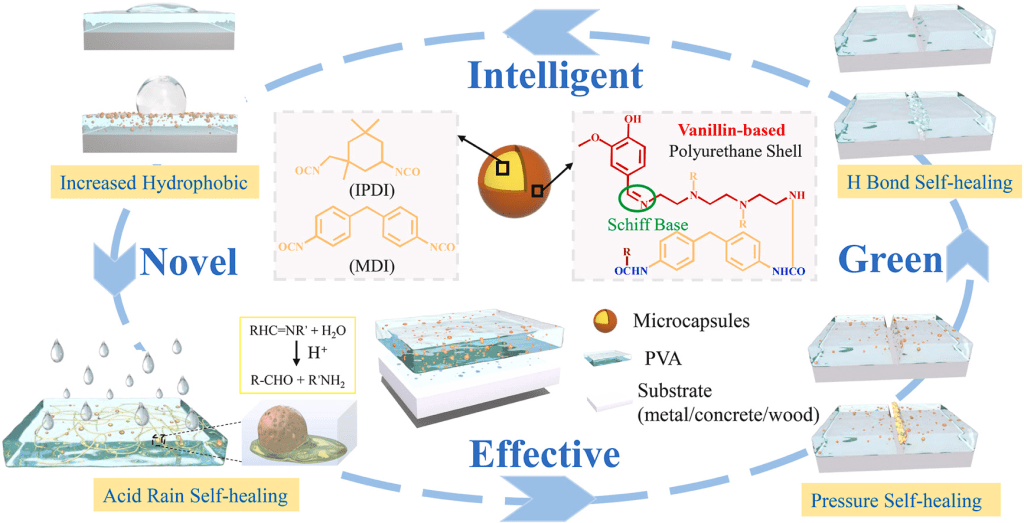
Self-healing technology based on microcapsules (MCs) holds great promise for preventing material performance deterioration, extending material lifespan, and reducing maintenance costs. In this study, a novel pH-responsive MC with a vanillin-based Schiff base polyurea shell and an isocyanate core was successfully prepared using interfacial polymerization. Vanillin-based Schiff base-containing triamines were synthesized, and their existence was confirmed through ATR-FTIR and 1H NMR analyses. The core-shell structures of the MCs were identified using FTIR and TGA. Additionally, the excellent response of the MCs to acid rain was demonstrated by determining the core content and recording optical images of the healing agent release process, with the fastest release rate observed at a pH of 2.98. According to the FTIR and TGA results, the release of the healing agent was continuous rather than occurring once. The MCs were incorporated into outdoor building materials (OBMs) (carbon steel, concrete, and wood) as a coating in conjunction with paint or polyvinyl alcohol (PVA). The pressure response, hydrogen bonding response, and hydrophobicity of the composite coating were assessed using SEM and water contact angle measurements. After subjecting the materials to 50 cycles of acid rain wet-dry tests (pH = 5.03), the carbon steel remained largely rust-free, whereas untreated carbon steel could only withstand a single cycle. Consequently, this study highlights a novel green structure and scalable manufacturing process for functional self-healing MCs, with significant implications for the advancement of stimulus-responsive composite materials and the realization of a sustainable and environmentally friendly economy.

New Article: Superhydrophobic polyurethane foam based on castor oil and lignin with SiC nanoparticles for efficient and recyclable oil-water separation

A new article out of a collaboration between Dr. Ning Yan and Dr. Jing Chen’s labs has been published in the Journal of Water Process Engineering written by Wanrong Lv, Jialong Wu, Xiaozhen Ma, Xiaobo Xu, Xiaolin Wang, Jin Zhu, Ning Yan, and Jing Chen.
You can find the article here.

Click here to see the full article until March 29, 2024

Abstract

Superhydrophobic polyurethane foam has great potential to be used as adsorbent for cleaning up oil spills. In this study, lignin and castor oil were used as alternative resources to petroleum-based raw materials for the production of degradable polyurethane foams for oil spill treatment. SiC was first modified by 1H, 1H, 2H, 2H-perfluorododecyltrichlorosilane (FDTS) to obtain F-SiC. F-SiC was superhydrophobicity with an irregular crystalline structure of diameters ranging from 20 to 500 nm. It was incorporated into the matrix of lignin and castor oil derived polyurethane foam. With the addition of F-SiC, the water contact angle of the foam increased to 151.7 °C to render the foam superhydrophobic. After 100 cycles of mechanical compression, the foam showed a good elastic recovery ability. It is shown in SEM that F-SiC was distributed on the foam skeleton. Under 1 KW/m2 sunlight intensity, the temperature of the foam went up to 88.8 °C. On top of that, the foam showed excellent self-cleaning and oil-absorbing properties. It degraded within 4 h in alkaline solutions. Therefore, these castor oil and lignin derived bio-based polyurethane foams possess good mechanical stability, fast oil absorption, and alkaline degradability which has good application prospects in oil spill cleanup.

New article: Fully biomass-derived polyurethane based on dynamic imine with self-healing, rapid degradability, and editable shape memory capabilities

A new article out of a collaboration between Dr. Ning Yan and Dr. Jing Chen’s labs has been published in Chemical Engineering Journal written by Xiaobo Xu, Xiaozhen Ma, Minghui Cui, Honglong Zhao, Nathan E. Stott, Jin Zhu, Ning Yan, and Jing Chen.

You can find this article HERE.

Abstract

In this study, a novel bio-based diol containing imine dynamic bonds (Vanp2) were synthesized using vanillin and bio-based 1,5-pentanediamine. Vanp2 was then introduced into the cross-linking network of betulin-based polyurethanes to obtain betulin-based polyurethanes containing covalent adaptive networks (CANs). Imine dynamic bonds within CAN endowed these betulin-based polyurethanes with self-healing, re-processability, degradability, and editable shape memory functionalities. Meanwhile, the mechanical and thermal properties of these fully bio-based polyurethane materials were characterized. The maximum tensile strength reached 9.5 MPa, while the maximum strain at break was 248 % and the maximum toughness was 13.2 MJ/m3. Thermal decomposition temperature was greater than 300 °C. Since the imine structure could be dissociated under acidic conditions, these polyurethanes could be rapidly degraded in a mixed acid solution at 50 °C in 4 h. This study demonstrated a strategy for synthesizing betulin-based polyurethane elastomers containing CAN using only bio-based feedstock.

New article: Catalyst-Free Synthesis of Betulin-Based Polyurethane Elastomers with Outstanding Mechanical Properties and Solvent Resistance

A new article out of a collaboration between Dr. Ning Yan and Dr. Jing Chen’s labs has been published been published in ACS Applied Polymer Materials written by Xiaobo Xu, Xiaozhen Ma, Xiaolin Wang, Jin Zhu, Jinggang Wang, Ning Yan, and Jing Chen.

You can find this article HERE.

Abstract

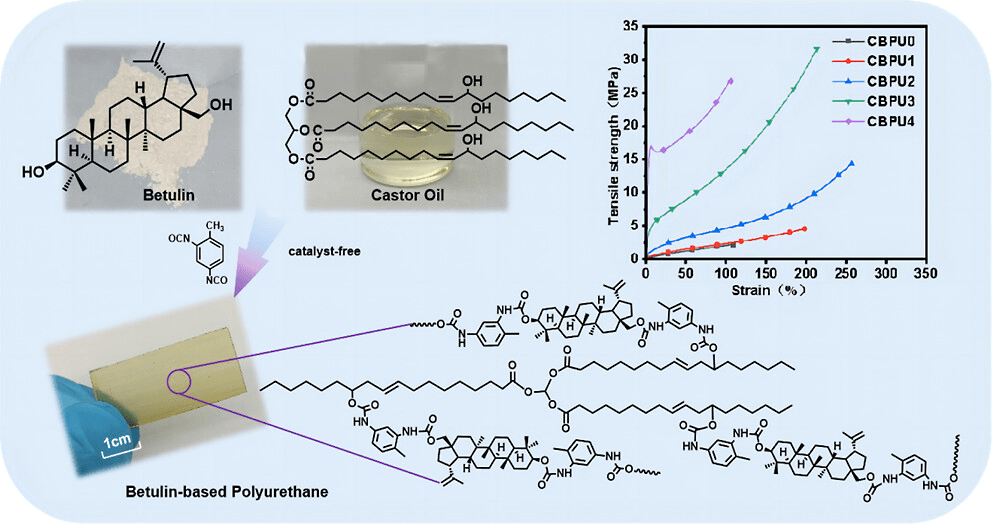
Using sustainable biomass feedstock to prepare biobased chemical products is attracting increasing attention. Betulin is a natural cyclic aliphatic diol that can be extracted in large quantities from the bark of birch trees. In this study, a series of bio-based polyurethane (PU) elastomers with excellent mechanical properties, solvent resistance, and thermal stability were synthesized under catalyst-free conditions using betulin and castor oil (CO) as the bio-based polyols. The chemical structure and properties of the bio-based PU elastomers were systematically investigated according to the effect of the hydroxyl ratio between betulin and CO. Due to the presence of abundant hydrogen bonds and rigid ring planes in the PU structure, and a higher cross-link density, the obtained PU elastomers had excellent mechanical properties. They achieved a maximum tensile strength of 31.6 MPa with the tensile strain reaching more than 200% and were able to withstand 1 × 10⁵ times their weight. The thermal decomposition temperature of the betulin-derived PUs was over 300 °C. This study showcased a strategy to synthesize sustainable high-performance PU materials with a high biomass content (>75%).

New article: Flame-retardant Janus ramie fabric with unidirectional liquid transportation, moisture-wicking, and oil/water separation properties

A new article out of a collaboration between Dr. Ning Yan and Dr. Jing Chen’s labs has been published in Chemical Engineering Journal written by Huihui Wang, Cheng Hao, Tong Shu, Pandeng Li, Tianyi Yu, Longjiang Yu, and Ning Yan.

You can find the article HERE.

Abstract

Janus fabrics are often used for oil/water separation, fog-harvesting, and moisture-wicking clothing due to their unidirectional liquid transport (ULT) ability. However, Janus fabrics are usually mono-functional, and the fabrication process is complex. Moreover, the chemicals used are not green. Herein, a versatile Janus fabric from ramie with ULT, flame retardancy, and moisture-wicking features was fabricated using a facile and sustainable method. Chitosan and phytic acid were rapidly deposited on the surface of fabrics via electrostatic gravitation, and polydivinylbenzene was then used as coating after in situ polymerization. Reverse wettability was achieved on two sides of the Janus ramie fabric after the UV irradiation of one of the sides, which endowed the fabric with ULT ability. Janus ramie fabric exhibited a comparable water vapor transmission rate to that of pristine ramie fabric but a higher water evaporation rate because of its ULT ability, indicating an improved moisture-wicking ability. Furthermore, the Janus ramie fabric displayed a good oil/water mixture separation performance with a separation efficiency of over 98% and good mechanical abrasion and chemical resistance. More importantly, the Janus ramie fabric showed excellent flame retardancy, a self-extinguishing ability, and a high limiting oxygen index of 34.5%, and its heat release rate, heat release capacity, and total heat release rate were significantly lower than those of pristine fabric. Therefore, this versatile Janus ramie fabric demonstrates great potential for various practical applications.