
We’re pleased to share our new review, “Development of bio-based flame-retardant polyurethane,” published in Chemical Society Reviews.
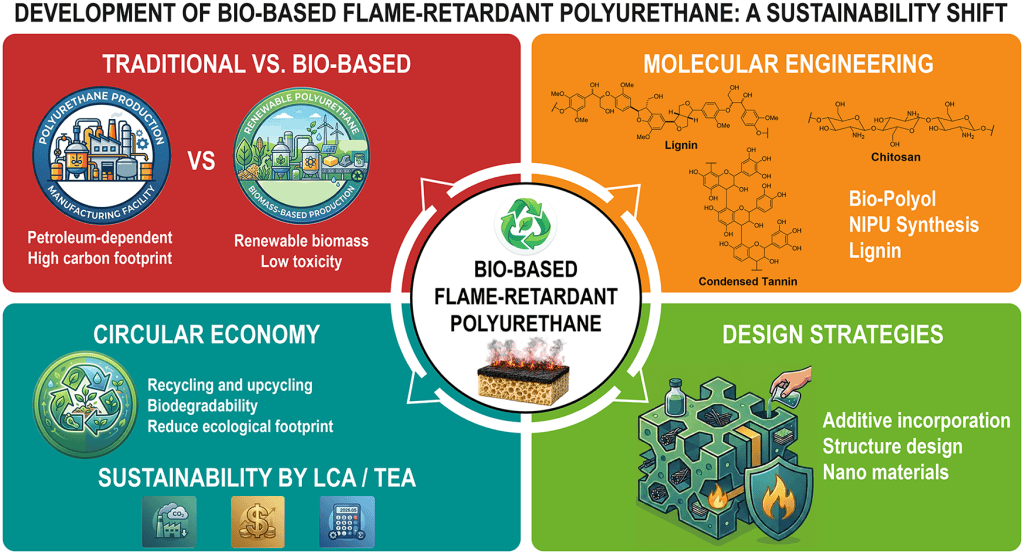
Polyurethanes are used in everything from insulation and furniture foams to coatings and adhesives, but they can burn readily. Conventional formulations often rely on petrochemical feedstocks, while some halogenated flame retardants raise health and environmental concerns. Our review explores how polyurethane materials can be designed for both fire safety and sustainability.
We examine renewable resources such as lignin, chitosan, proteins, phytic acid, and tannins, and how they can help materials form a protective char during a fire. We also discuss non-isocyanate polyurethanes, layered coatings, and microencapsulation as approaches to improving fire performance while maintaining useful material properties.
The review also looks beyond fire testing to consider life-cycle impacts, circularity, and the practical challenges of producing these materials at scale. By connecting molecular design with material performance and sustainability, we hope to help guide the development of polyurethanes that can meet real-world needs.

