New article: Chitosan-based partial Vitrimer for making eco-friendly multifunctional ramie fabric reinforced composite

A new article from Ning Yan’s lab has been published in International Journal of Biological Macromolecules written by Mohammad H. Mahaninia and Ning Yan.

You can find the article for free here until June 03, 2025.
Abstract

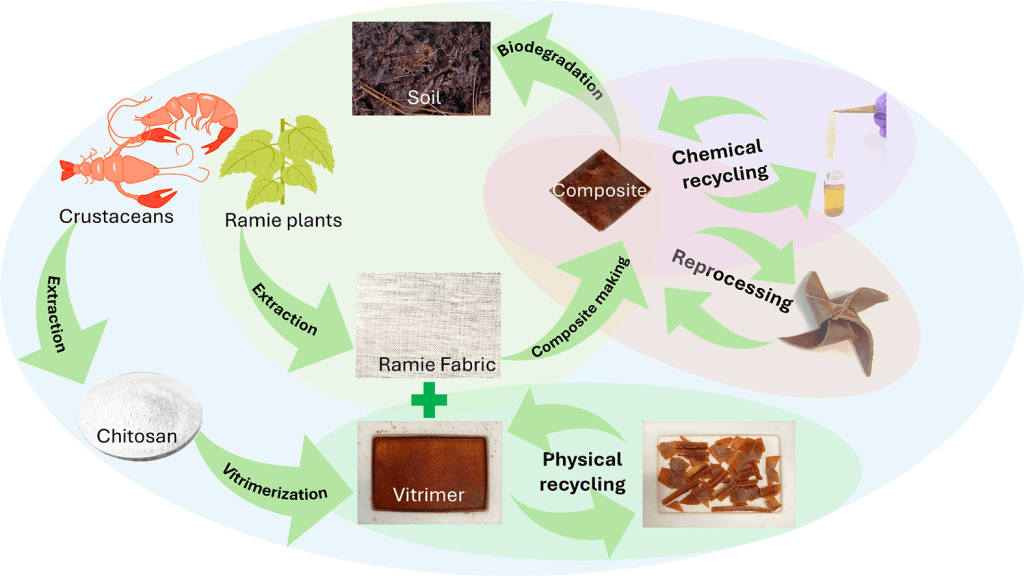
In this study, a novel chitosan-based partial vitrimer was synthesized and used as the matrix material to fabricate eco-friendly fully bio-based polymer composites reinforced with ramie fabric. The chitosan-based partial vitrimers were prepared by a facile and green chemistry method without the use of catalyst. It contained amide bonds that could undergo transamidation bond exchange reactions autocatalyzed by the nearby functional groups. Using this partial vitrimer, a recyclable/biodegradable biocomposite reinforced with 40 wt% of ramie fabric was fabricated by using the hot-pressing method. The biocomposite showed excellent mechanical properties (e.g., tensile strength of 124 MPa) compared to other chitosan-based natural fiber composites reported in the literature. Benefiting from the self-healing, shape memory, and reprocessibility of the chitosan-based vitrimeric matrix, the resulting ramie fabric biocomposite also exhibited remoldability, shape memory, and self-adhesive properties. The ramie fabric composite was fully biodegraded in 12 weeks while the vitrimeric matrix alone biodegraded only in 2 weeks. These findings highlight the potential of chitosan-based partial vitrimer in developing high-performance, multifunctional, and sustainable biocomposites for various applications.

New Article: Highly Conducting and Ultra-Stretchable Wearable Ionic Liquid-Free Transducer for Wireless Monitoring of Physical Motions

A new article from Ning Yan’s lab has been published in Macromolecular Rapid Communications written by Nicolas R. Tanguy, Araz Rajabi-Abhari, Eric Williams-Linera, Zheyuan Miao, Nicole Tratnik, Xiao Zhang, Cheng Hao, Alvin Virya, Ning Yan, and Ronan Le Lagadec.

You can find the article here

Abstract

Wearable strain transducers are poised to transform the field of healthcare owing to the promise of personalized devices capable of real-time collection of human physiological health indicators. For instance, monitoring patients’ progress following injury and/or surgery during physiotherapy is crucial but rarely performed outside clinics. Herein, multifunctional liquid-free ionic elastomers are designed through the volume effect and the formation of dynamic hydrogen bond networks between polyvinyl alcohol (PVA) and weak acids (phosphoric acid, phytic acid, formic acid, citric acid). An ultra-stretchable (4600% strain), highly conducting (10 mS cm-1), self-repairable (77% of initial strain), and adhesive ionic elastomer is obtained at high loadings of phytic acid (4:1 weight to PVA). Moreover, the elastomer displayed durable performances, with intact mechanical properties after a year of storage. The elastomer is used as a transducer to monitor human motions in a device comprising an ESP32-based development board. The device detected walking and/or running biomechanics and communicated motion-sensing data (i.e., amplitude, frequency) wirelessly. The reported technology can also be applied to other body parts to monitor recovery after injury and/or surgery and inform practitioners of motion biomechanics remotely and in real time to increase convalescence effectiveness, reduce clinic appointments, and prevent injuries.

New Article: Catalyst-Free Biodegradable Chitosan-Based Dual Dynamic Covalent Networks with Self-Healing and Flame-Retardant Properties

A new article from Ning Yan’s lab has been published in ACS Sustainable Chemistry & Engineering written by Mohammad H. Mahaninia and Ning Yan.

You can find the article here

Abstract

Synthesizing covalent adaptable networks (CANs) from chitosan has been difficult due to its inherent insolubility in organic solvents. In this study, we report a facile approach for obtaining biobased flame-retarding CANs using chitosan as the starting material without dissolving it. These novel CANs were prepared via a dual cross-linking strategy in which chitosan consecutively reacted with citric acid and a vanillin-based cross-linker containing a flame-retarding moiety. The chitosan-based CANs attained dual dynamic bond-exchange sites resulting from generation of amide and ester linkages, which enabled them to perform self-healing and recyclability. They also possessed remarkable flame-retarding performance (e.g., limiting oxygen index of 41.5% and UL-94 V-0 rating), surpassing other chitosan-based flame retardants reported in the literature to date. By investigating the CAN’s response to fire in both gas and condensed phases, their flame-retarding mechanisms were uncovered. This study pinpoints a promising approach to make biobased, biodegradable, and multifunctional CANs from chitosan.

New Article: Self-healable, recyclable, and mechanically robust vitrimer composite for high-performance triboelectric nanogenerators and self-powered wireless electronics

A new article from Ning Yan’s lab has been published in Nano Energy written by Araz Rajabi-Abhari, Pandeng Li, Majid Haji Bagheri, Asif Abdullah Khan, Cheng Hao, Nicolas R. Tanguy, Dayan Ban, Longjiang Yu, and Ning Yan.

You can find the article here

Abstract

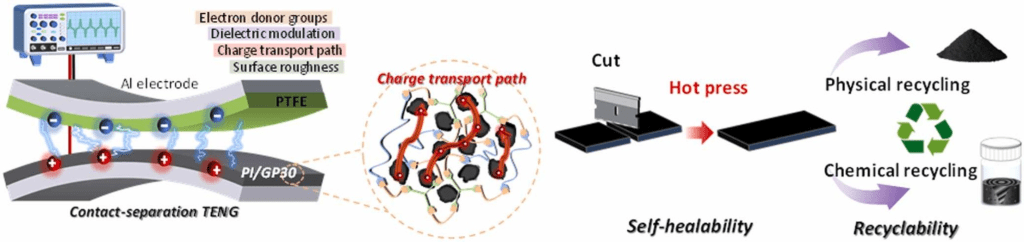
With growing concerns about sustainability, there has been significant research interest in fabricating triboelectric nanogenerators (TENGs) from materials capable of self-repair. Here, we presented a novel polyimine/graphite polypropylene (PI/GP) vitrimer composite as a tribo-positive material for harvesting biomechanical energy. The PI/GP exhibited mechanical robustness, self-healing properties after damage, and recyclability through physical or chemical methods. The GP provided a high dielectric constant, charge transport paths, and desirable surface roughness, resulting in an outstanding TENG performance at an optimized addition level of 30 wt% in the composite (PI/GP30). Under a force of 15 N and a frequency of 6 Hz, the PI/GP30 TENG generated a power density of 2571 mW/m². Moreover, a PI/GP30 TENG device with an area of 49 cm2 was able to generate a remarkable output voltage of nearly 1325 V, at a frequency of 6 Hz and under a vertical force of 15 N. Additionally, the PI/GP30 TENG device produced a peak-to-peak voltage of 1250 V, and an outstanding current of around 2 mA by hand tapping with a force of 35–40 N. The PI/GP30 TENG was utilized for real-life applications, including a triboelectric watchband for a self-powered watch, and wireless data transmission. Furthermore, the PI/GP30 TENG demonstrated excellent self-healing and recyclability, and these properties were examined in a mousepad power generator. This study highlights the excellent promise of PI/GP vitrimer composite for fabricating high-performance, mechanically robust, self-healable, and recyclable TENGs, enabling their applications in green biomechanical power generators and wearable and wireless communication devices.