New Article: Novel Cellulosic Fiber Composites with Integrated Multi-Band Electromagnetic Interference Shielding and Energy Storage Functionalities

A new article from Ning Yan’s lab has been published in Nano-Micro Letters written by Xuewen Han, Cheng Hao, Yukang Peng, Han Yu, Tao Zhang, Haonan Zhang, Kaiwen Chen, Heyu Chen, Zhenxing Wang, Ning Yan & Junwen Pu.

You can find the article here
Abstract

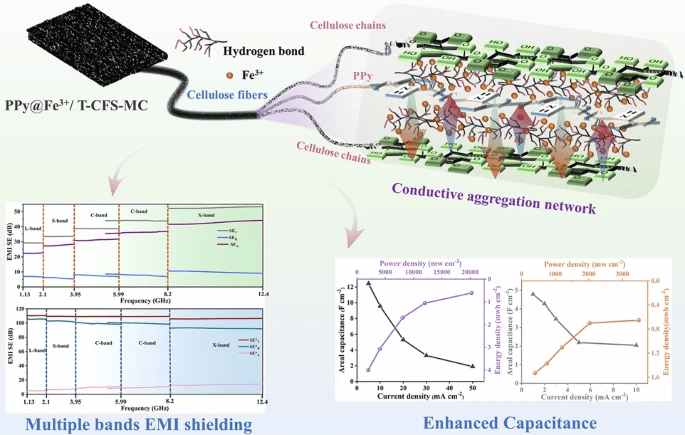
In an era where technological advancement and sustainability converge, developing renewable materials with multifunctional integration is increasingly in demand. This study filled a crucial gap by integrating energy storage, multi-band electromagnetic interference (EMI) shielding, and structural design into bio-based materials. Specifically, conductive polymer layers were formed within the 2,2,6,6-tetramethylpiperidine-1-oxide (TEMPO)-oxidized cellulose fiber skeleton, where a mild TEMPO-mediated oxidation system was applied to endow it with abundant macropores that could be utilized as active sites (specific surface area of 105.6 m2 g−1). Benefiting from the special hierarchical porous structure of the material, the constructed cellulose fiber-derived composites can realize high areal-specific capacitance of 12.44 F cm−2 at 5 mA cm−2 and areal energy density of 3.99 mWh cm−2 (2005 mW cm−2) with an excellent stability of maintaining 90.23% after 10,000 cycles at 50 mA cm−2. Meanwhile, the composites showed a high electrical conductivity of 877.19 S m−1 and excellent EMI efficiency (> 99.99%) in multiple wavelength bands. The composite material’s EMI values exceed 100 dB across the L, S, C, and X bands, effectively shielding electromagnetic waves in daily life. The proposed strategy paves the way for utilizing bio-based materials in applications like energy storage and EMI shielding, contributing to a more sustainable future.
New Article: Self-healable, recyclable, and mechanically robust vitrimer composite for high-performance triboelectric nanogenerators and self-powered wireless electronics

A new article from Ning Yan’s lab has been published in Nano Energy written by Araz Rajabi-Abhari, Pandeng Li, Majid Haji Bagheri, Asif Abdullah Khan, Cheng Hao, Nicolas R. Tanguy, Dayan Ban, Longjiang Yu, and Ning Yan.

You can find the article here

Abstract

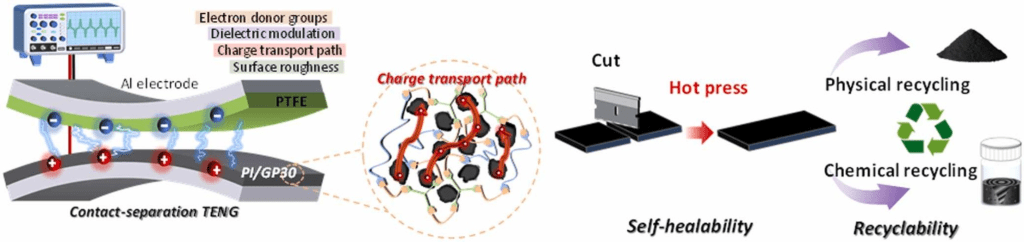
With growing concerns about sustainability, there has been significant research interest in fabricating triboelectric nanogenerators (TENGs) from materials capable of self-repair. Here, we presented a novel polyimine/graphite polypropylene (PI/GP) vitrimer composite as a tribo-positive material for harvesting biomechanical energy. The PI/GP exhibited mechanical robustness, self-healing properties after damage, and recyclability through physical or chemical methods. The GP provided a high dielectric constant, charge transport paths, and desirable surface roughness, resulting in an outstanding TENG performance at an optimized addition level of 30 wt% in the composite (PI/GP30). Under a force of 15 N and a frequency of 6 Hz, the PI/GP30 TENG generated a power density of 2571 mW/m². Moreover, a PI/GP30 TENG device with an area of 49 cm2 was able to generate a remarkable output voltage of nearly 1325 V, at a frequency of 6 Hz and under a vertical force of 15 N. Additionally, the PI/GP30 TENG device produced a peak-to-peak voltage of 1250 V, and an outstanding current of around 2 mA by hand tapping with a force of 35–40 N. The PI/GP30 TENG was utilized for real-life applications, including a triboelectric watchband for a self-powered watch, and wireless data transmission. Furthermore, the PI/GP30 TENG demonstrated excellent self-healing and recyclability, and these properties were examined in a mousepad power generator. This study highlights the excellent promise of PI/GP vitrimer composite for fabricating high-performance, mechanically robust, self-healable, and recyclable TENGs, enabling their applications in green biomechanical power generators and wearable and wireless communication devices.