New Article: Superhydrophobic polyurethane foam based on castor oil and lignin with SiC nanoparticles for efficient and recyclable oil-water separation

A new article out of a collaboration between Dr. Ning Yan and Dr. Jing Chen’s labs has been published in the Journal of Water Process Engineering written by Wanrong Lv, Jialong Wu, Xiaozhen Ma, Xiaobo Xu, Xiaolin Wang, Jin Zhu, Ning Yan, and Jing Chen.
You can find the article here.

Click here to see the full article until March 29, 2024

Abstract

Superhydrophobic polyurethane foam has great potential to be used as adsorbent for cleaning up oil spills. In this study, lignin and castor oil were used as alternative resources to petroleum-based raw materials for the production of degradable polyurethane foams for oil spill treatment. SiC was first modified by 1H, 1H, 2H, 2H-perfluorododecyltrichlorosilane (FDTS) to obtain F-SiC. F-SiC was superhydrophobicity with an irregular crystalline structure of diameters ranging from 20 to 500 nm. It was incorporated into the matrix of lignin and castor oil derived polyurethane foam. With the addition of F-SiC, the water contact angle of the foam increased to 151.7 °C to render the foam superhydrophobic. After 100 cycles of mechanical compression, the foam showed a good elastic recovery ability. It is shown in SEM that F-SiC was distributed on the foam skeleton. Under 1 KW/m2 sunlight intensity, the temperature of the foam went up to 88.8 °C. On top of that, the foam showed excellent self-cleaning and oil-absorbing properties. It degraded within 4 h in alkaline solutions. Therefore, these castor oil and lignin derived bio-based polyurethane foams possess good mechanical stability, fast oil absorption, and alkaline degradability which has good application prospects in oil spill cleanup.
New article: Fully biomass-derived polyurethane based on dynamic imine with self-healing, rapid degradability, and editable shape memory capabilities

A new article out of a collaboration between Dr. Ning Yan and Dr. Jing Chen’s labs has been published in Chemical Engineering Journal written by Xiaobo Xu, Xiaozhen Ma, Minghui Cui, Honglong Zhao, Nathan E. Stott, Jin Zhu, Ning Yan, and Jing Chen.

You can find this article HERE.

Abstract

In this study, a novel bio-based diol containing imine dynamic bonds (Vanp2) were synthesized using vanillin and bio-based 1,5-pentanediamine. Vanp2 was then introduced into the cross-linking network of betulin-based polyurethanes to obtain betulin-based polyurethanes containing covalent adaptive networks (CANs). Imine dynamic bonds within CAN endowed these betulin-based polyurethanes with self-healing, re-processability, degradability, and editable shape memory functionalities. Meanwhile, the mechanical and thermal properties of these fully bio-based polyurethane materials were characterized. The maximum tensile strength reached 9.5 MPa, while the maximum strain at break was 248 % and the maximum toughness was 13.2 MJ/m3. Thermal decomposition temperature was greater than 300 °C. Since the imine structure could be dissociated under acidic conditions, these polyurethanes could be rapidly degraded in a mixed acid solution at 50 °C in 4 h. This study demonstrated a strategy for synthesizing betulin-based polyurethane elastomers containing CAN using only bio-based feedstock.

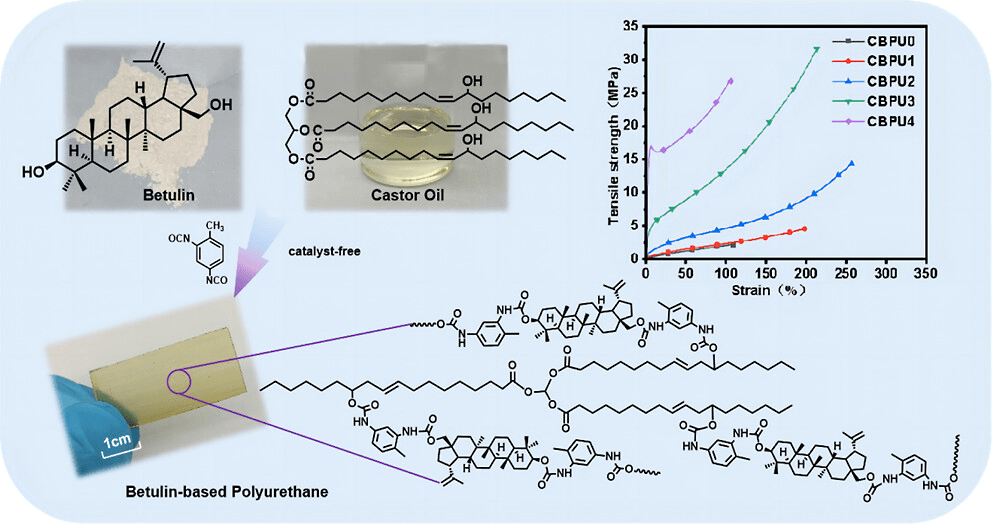
New article: Catalyst-Free Synthesis of Betulin-Based Polyurethane Elastomers with Outstanding Mechanical Properties and Solvent Resistance

A new article out of a collaboration between Dr. Ning Yan and Dr. Jing Chen’s labs has been published been published in ACS Applied Polymer Materials written by Xiaobo Xu, Xiaozhen Ma, Xiaolin Wang, Jin Zhu, Jinggang Wang, Ning Yan, and Jing Chen.

You can find this article HERE.

Abstract

Using sustainable biomass feedstock to prepare biobased chemical products is attracting increasing attention. Betulin is a natural cyclic aliphatic diol that can be extracted in large quantities from the bark of birch trees. In this study, a series of bio-based polyurethane (PU) elastomers with excellent mechanical properties, solvent resistance, and thermal stability were synthesized under catalyst-free conditions using betulin and castor oil (CO) as the bio-based polyols. The chemical structure and properties of the bio-based PU elastomers were systematically investigated according to the effect of the hydroxyl ratio between betulin and CO. Due to the presence of abundant hydrogen bonds and rigid ring planes in the PU structure, and a higher cross-link density, the obtained PU elastomers had excellent mechanical properties. They achieved a maximum tensile strength of 31.6 MPa with the tensile strain reaching more than 200% and were able to withstand 1 × 10⁵ times their weight. The thermal decomposition temperature of the betulin-derived PUs was over 300 °C. This study showcased a strategy to synthesize sustainable high-performance PU materials with a high biomass content (>75%).

New article: Flame-retardant Janus ramie fabric with unidirectional liquid transportation, moisture-wicking, and oil/water separation properties

A new article out of a collaboration between Dr. Ning Yan and Dr. Jing Chen’s labs has been published in Chemical Engineering Journal written by Huihui Wang, Cheng Hao, Tong Shu, Pandeng Li, Tianyi Yu, Longjiang Yu, and Ning Yan.

You can find the article HERE.

Abstract

Janus fabrics are often used for oil/water separation, fog-harvesting, and moisture-wicking clothing due to their unidirectional liquid transport (ULT) ability. However, Janus fabrics are usually mono-functional, and the fabrication process is complex. Moreover, the chemicals used are not green. Herein, a versatile Janus fabric from ramie with ULT, flame retardancy, and moisture-wicking features was fabricated using a facile and sustainable method. Chitosan and phytic acid were rapidly deposited on the surface of fabrics via electrostatic gravitation, and polydivinylbenzene was then used as coating after in situ polymerization. Reverse wettability was achieved on two sides of the Janus ramie fabric after the UV irradiation of one of the sides, which endowed the fabric with ULT ability. Janus ramie fabric exhibited a comparable water vapor transmission rate to that of pristine ramie fabric but a higher water evaporation rate because of its ULT ability, indicating an improved moisture-wicking ability. Furthermore, the Janus ramie fabric displayed a good oil/water mixture separation performance with a separation efficiency of over 98% and good mechanical abrasion and chemical resistance. More importantly, the Janus ramie fabric showed excellent flame retardancy, a self-extinguishing ability, and a high limiting oxygen index of 34.5%, and its heat release rate, heat release capacity, and total heat release rate were significantly lower than those of pristine fabric. Therefore, this versatile Janus ramie fabric demonstrates great potential for various practical applications.

New article: Self-healing, flame-retardant, and antimicrobial chitosan-based dynamic covalent hydrogelsNew article:

A new article from Ning Yan’s lab has been published in International Journal of Biological Macromolecules written by Mohammad H. Mahaninia, Zhuoya Wang, Araz Rajabi-Abhari, and Ning Yan.

You can find this article HERE.

Abstract

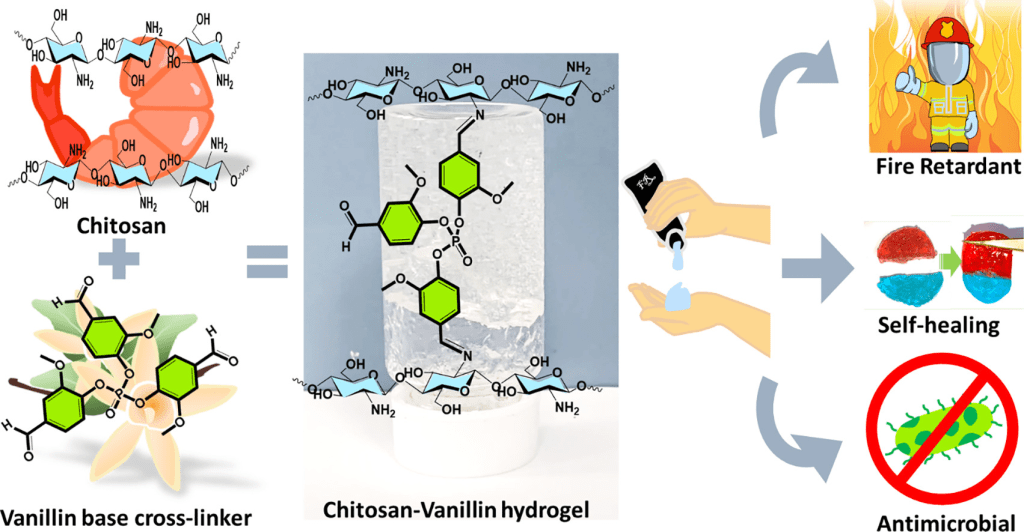
This study reports the fabrication of chitosan-based hydrogels with potential to be applied as a flame-retardant coating on skin or other surfaces. These hydrogels possess remarkable antimicrobial properties that are highly desirable for the protection of epidermises. Hydrogels in this study were prepared via the cross-linking reaction of chitosan with a vanillin-based cross linker containing flame-retarding moieties through Schiff’s base reaction. The synthesized hydrogels possess imine linkages enabling them to self-heal at room temperature. Self-healing abilities offered these hydrogels the ability to protect the skin for a longer time. One flame retarding mechanism of these hydrogels was by retaining the water in their polymeric network; thus, the role of bound and unbound water molecules was studied using DSC and Raman spectroscopy. The hydrogels synthesized in this study retained their flame-retarding properties even after drying due to the charring process that inhibited the pyrolysis process. Therefore, these chitosan-based hydrogels are able to prolong the protection time against fire.

New article: Nature-inspired surface for simultaneously harvesting water and triboelectric energy from ambient humidity using polymer brush coatingsNew article:

A new article from Ning Yan’s lab has been published in Nano Energy written by Araz Rajabi-Abhari, Mohammad Soltani, Kevin Golovin, and Ning Yan.

You can find this article HERE.

Abstract

Atmospheric water harvesting provides a promising, sustainable solution for alleviating the ever-growing water and energy crisis. Here, inspired by the Namib desert beetle, a wettability patterned surface was designed to simultaneously harvest water and triboelectric energy from ambient moisture. Indium tin oxide (ITO) conductive glass was coated by environmentally friendly perfluoropolyether (PFPE) polymer brushes to obtain a hydrophobic surface, decorated by hydrophilic patterns. The PFPE brushes enabled the droplet to slide down and served as the tribonegative material. The water and triboelectric energy harvesting performance of the hydrophilic-hydrophobic “patterned water and energy harvesting” (P-WEH) system was then investigated. In this regard, a water collection rate of 703 mg cm-2 h-1 was achieved when the P-WEH was placed within an artificial fog. The influence of pattern size and tilt angle, and their relationship with water droplet volume and speed on the triboelectric output, were measured. The effect of the water harvesting area on the output performance of the P-WEH was investigated. The P-WEH with an area of 100 cm2 and a tilt angle of 60° exhibited a high output current of 8.15 µA and a maximum output power of 3.35 µW. Finally, the P-WEH was integrated into a four-season greenhouse to demonstrate its application in reducing external water-energy consumption. This study presents insights into the design of simultaneous water and energy harvesting systems and may contribute to building a sustainable society.

Open Post-Doctoral Research Positions

Join Prof. Ning Yan’s Lab at the University of Toronto. We’re seeking a highly motivated Postdoctoral Researcher to work on developing functional bio-based polymers. This 1-year appointment can be extended. Start immediately.

Requirements:

  • Ph.D. in Polymer Chemistry, Materials Science, or related field
  • Strong background in polymer chemistry and materials characterization
  • Experience in biopolymer/material synthesis and modification, polymer/composite processing, and material characterization is highly desirable
  • Excellent communication and interpersonal skills

To apply, please email your CV and research statement to Prof. Ning Yan at ning.yan@utoronto.ca. Please note that only candidates selected for an interview will be contacted.