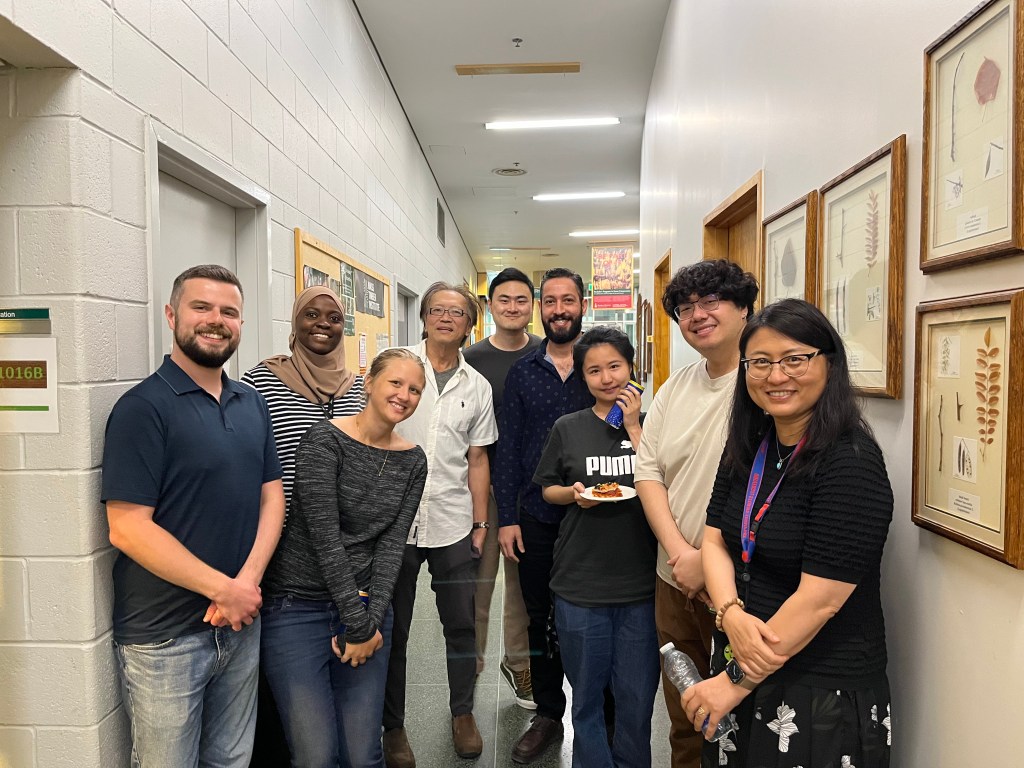
Today we celebrate Tony Ung’s retirement, a staple of the Faculty of Forestry who has helped keep things running in the Earth Science Center. Whenever we had an issue or a question, Tony was always there to give us guidance. He was never too busy to lend a hand even though he had many, many responsibilities. Our lab would look a lot different without his help. He will be sorely missed. Congratulations on your retirement Tony!
On December 10th a member of Prof. Ning Yan’s Lab, Troy Su, successfully passed his qualifying exam signifying he is able to continue with his PhD studies. In the next few years he will continue his work on lignocellulose-reinforced bio-composites.
A new article out of Ning Yan’s lab has been published in Carbohydrate Polymers about flexible gas sensors made with lignocellulosic nanfibrils written by Nicolas R.Tanguy, Kasra Khorsand Kazemi, Jordan Hong, Krisco-Cheuk Cheung, Sevda Mohammadi, PitchaimariGnanasekar, Sandeep S.Nair, Mohammad H.Zarifi, and Ning Yan
Gas detection in flexible electronics demands novel materials with superior sensing performance that have high mechanical strength, are flexible, low-cost, and sustainable. We explore a composite sensing nanopaper based on lignocellulosic cellulose nanofibrils (LCNF) as a renewable and mechanically strong substrate that enables the fabrication of flexible, and highly sensitive gas sensors. In the system the hydrophobic lignin covalently bonds to cellulose in the nanofibrils, increasing the nanopaper water-resistance and limiting sensing materials response to humidity. The sensor is composed of polyaniline (PANI) grown on flexible LCNF and reduced graphene oxide (rGO) nanosheets. The proposed structure, at 10 wt% rGO, demonstrated a 10-fold improvement in sensitivity to volatile amines (i.e. ammonia detection down to 1 ppm) while maintaining an acceptable selectivity. Furthermore, we demonstrated the application of the sensing nanopaper in a microwave sensor that paves the path toward flexible, wireless, and high-performance sensing devices.
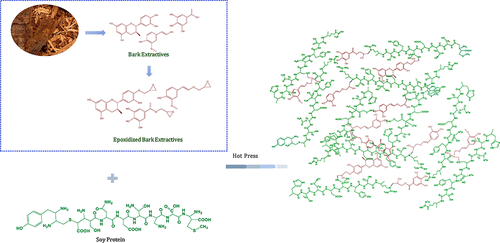
A new paper from the Yan lab has been published in ACS Sustainable Chemistry + Engineering titled From Wastes to Functions: A New Soybean Meal and Bark-Based Adhesive written by Jing Luo, Ying Zhou, Qiang Gao, Jianzhang Li, and Ning Yan
For the first 12 months of publication, 50 free e-prints are available for interested colleagues.
Click here to see the article and get your free e-print.



 Yan Lab