New article: Catalyst-Free Synthesis of Betulin-Based Polyurethane Elastomers with Outstanding Mechanical Properties and Solvent Resistance

A new article out of a collaboration between Dr. Ning Yan and Dr. Jing Chen’s labs has been published been published in ACS Applied Polymer Materials written by Xiaobo Xu, Xiaozhen Ma, Xiaolin Wang, Jin Zhu, Jinggang Wang, Ning Yan, and Jing Chen.

You can find this article HERE.
Abstract

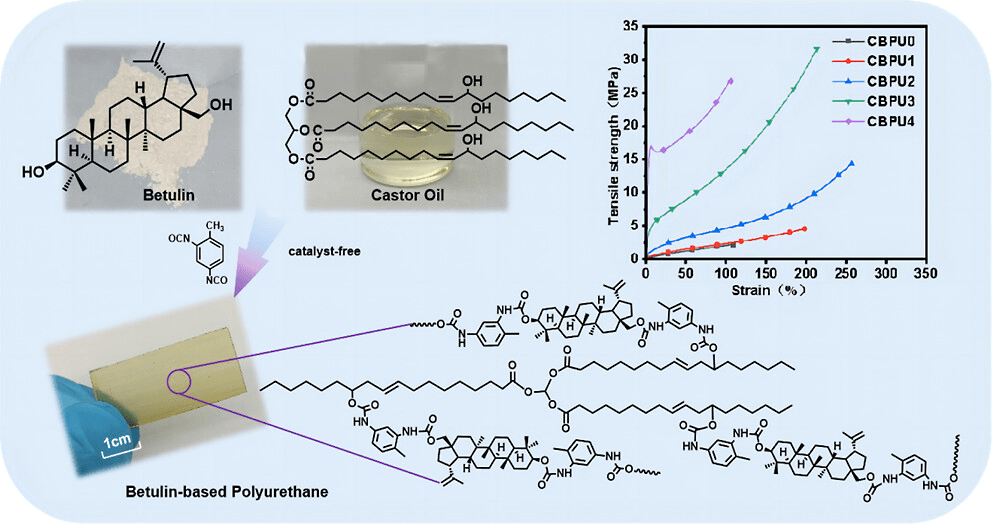
Using sustainable biomass feedstock to prepare biobased chemical products is attracting increasing attention. Betulin is a natural cyclic aliphatic diol that can be extracted in large quantities from the bark of birch trees. In this study, a series of bio-based polyurethane (PU) elastomers with excellent mechanical properties, solvent resistance, and thermal stability were synthesized under catalyst-free conditions using betulin and castor oil (CO) as the bio-based polyols. The chemical structure and properties of the bio-based PU elastomers were systematically investigated according to the effect of the hydroxyl ratio between betulin and CO. Due to the presence of abundant hydrogen bonds and rigid ring planes in the PU structure, and a higher cross-link density, the obtained PU elastomers had excellent mechanical properties. They achieved a maximum tensile strength of 31.6 MPa with the tensile strain reaching more than 200% and were able to withstand 1 × 10⁵ times their weight. The thermal decomposition temperature of the betulin-derived PUs was over 300 °C. This study showcased a strategy to synthesize sustainable high-performance PU materials with a high biomass content (>75%).

New article: Flame-retardant Janus ramie fabric with unidirectional liquid transportation, moisture-wicking, and oil/water separation properties

A new article out of a collaboration between Dr. Ning Yan and Dr. Jing Chen’s labs has been published in Chemical Engineering Journal written by Huihui Wang, Cheng Hao, Tong Shu, Pandeng Li, Tianyi Yu, Longjiang Yu, and Ning Yan.

You can find the article HERE.

Abstract

Janus fabrics are often used for oil/water separation, fog-harvesting, and moisture-wicking clothing due to their unidirectional liquid transport (ULT) ability. However, Janus fabrics are usually mono-functional, and the fabrication process is complex. Moreover, the chemicals used are not green. Herein, a versatile Janus fabric from ramie with ULT, flame retardancy, and moisture-wicking features was fabricated using a facile and sustainable method. Chitosan and phytic acid were rapidly deposited on the surface of fabrics via electrostatic gravitation, and polydivinylbenzene was then used as coating after in situ polymerization. Reverse wettability was achieved on two sides of the Janus ramie fabric after the UV irradiation of one of the sides, which endowed the fabric with ULT ability. Janus ramie fabric exhibited a comparable water vapor transmission rate to that of pristine ramie fabric but a higher water evaporation rate because of its ULT ability, indicating an improved moisture-wicking ability. Furthermore, the Janus ramie fabric displayed a good oil/water mixture separation performance with a separation efficiency of over 98% and good mechanical abrasion and chemical resistance. More importantly, the Janus ramie fabric showed excellent flame retardancy, a self-extinguishing ability, and a high limiting oxygen index of 34.5%, and its heat release rate, heat release capacity, and total heat release rate were significantly lower than those of pristine fabric. Therefore, this versatile Janus ramie fabric demonstrates great potential for various practical applications.

New article: Self-healing, flame-retardant, and antimicrobial chitosan-based dynamic covalent hydrogelsNew article:

A new article from Ning Yan’s lab has been published in International Journal of Biological Macromolecules written by Mohammad H. Mahaninia, Zhuoya Wang, Araz Rajabi-Abhari, and Ning Yan.

You can find this article HERE.

Abstract

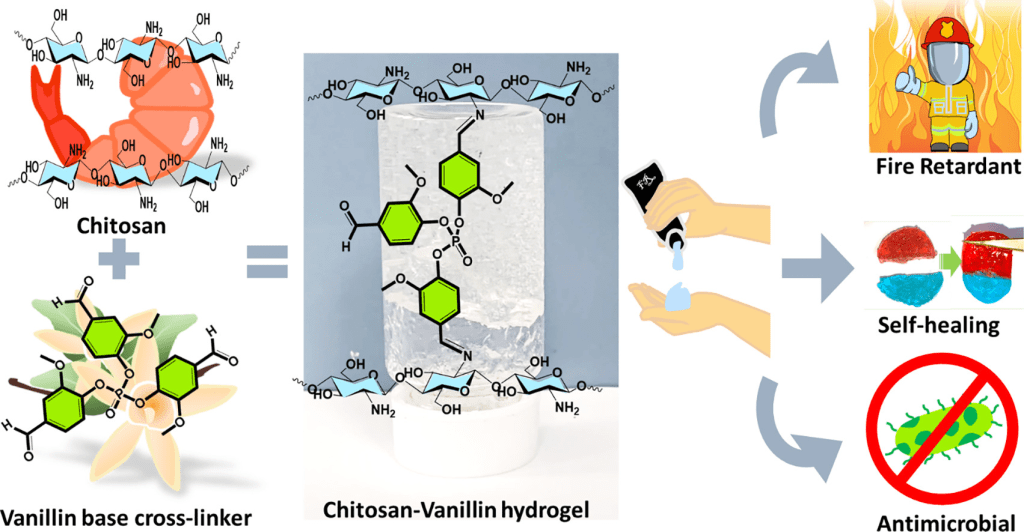
This study reports the fabrication of chitosan-based hydrogels with potential to be applied as a flame-retardant coating on skin or other surfaces. These hydrogels possess remarkable antimicrobial properties that are highly desirable for the protection of epidermises. Hydrogels in this study were prepared via the cross-linking reaction of chitosan with a vanillin-based cross linker containing flame-retarding moieties through Schiff’s base reaction. The synthesized hydrogels possess imine linkages enabling them to self-heal at room temperature. Self-healing abilities offered these hydrogels the ability to protect the skin for a longer time. One flame retarding mechanism of these hydrogels was by retaining the water in their polymeric network; thus, the role of bound and unbound water molecules was studied using DSC and Raman spectroscopy. The hydrogels synthesized in this study retained their flame-retarding properties even after drying due to the charring process that inhibited the pyrolysis process. Therefore, these chitosan-based hydrogels are able to prolong the protection time against fire.

New article: Nature-inspired surface for simultaneously harvesting water and triboelectric energy from ambient humidity using polymer brush coatingsNew article:

A new article from Ning Yan’s lab has been published in Nano Energy written by Araz Rajabi-Abhari, Mohammad Soltani, Kevin Golovin, and Ning Yan.

You can find this article HERE.

Abstract

Atmospheric water harvesting provides a promising, sustainable solution for alleviating the ever-growing water and energy crisis. Here, inspired by the Namib desert beetle, a wettability patterned surface was designed to simultaneously harvest water and triboelectric energy from ambient moisture. Indium tin oxide (ITO) conductive glass was coated by environmentally friendly perfluoropolyether (PFPE) polymer brushes to obtain a hydrophobic surface, decorated by hydrophilic patterns. The PFPE brushes enabled the droplet to slide down and served as the tribonegative material. The water and triboelectric energy harvesting performance of the hydrophilic-hydrophobic “patterned water and energy harvesting” (P-WEH) system was then investigated. In this regard, a water collection rate of 703 mg cm-2 h-1 was achieved when the P-WEH was placed within an artificial fog. The influence of pattern size and tilt angle, and their relationship with water droplet volume and speed on the triboelectric output, were measured. The effect of the water harvesting area on the output performance of the P-WEH was investigated. The P-WEH with an area of 100 cm2 and a tilt angle of 60° exhibited a high output current of 8.15 µA and a maximum output power of 3.35 µW. Finally, the P-WEH was integrated into a four-season greenhouse to demonstrate its application in reducing external water-energy consumption. This study presents insights into the design of simultaneous water and energy harvesting systems and may contribute to building a sustainable society.

New Article: High-Performance, Light-Stimulation Healable, and Closed-Loop Recyclable Lignin-Based Covalent Adaptable NetworksNew Article:

A new article out of a collaboration between Dr. Ning Yan and Dr. Jing Chen’s labs has been published in Small written by Xiaozhen Ma, Xiaolin Wang, Honglong Zhao, Xiaobo Xu, Minghui Cui, Nathan E. Stott, Peng Chen, Jin Zhu, Ning Yan, and Jing Chen.

You can find the article HERE.

Abstract

In this work, high-performance, light-stimulation healable, and closed-loop recyclable covalent adaptable networks are successfully synthesized from natural lignin-based polyurethane (LPU) Zn2+ coordination structures (LPUxZy). Using an optimized LPU (LPU-20 with a tensile strength of 28.4 ± 3.5 MPa) as the matrix for Zn2+ coordination, LPUs with covalent adaptable coordination networks are obtained that have different amounts of Zn. When the feed amount of ZnCl2 is 9 wt%, the strength of LPU-20Z9 reaches 37.3 ± 3.1 MPa with a toughness of 175.4 ± 4.6 MJ m−3, which is 1.7 times of that of LPU-20. In addition, Zn2+ has a crucial catalytic effect on “dissociation mechanism” in the exchange reaction of LPU. Moreover, the Zn2+-based coordination bonds significantly enhance the photothermal conversion capability of lignin. The maximum surface temperature of LPU-20Z9 reaches 118 °C under the near-infrared illumination of 0.8 W m−2. This allows the LPU-20Z9 to self-heal within 10 min. Due to the catalytic effect of Zn2+, LPU-20Z9 can be degraded and recovered in ethanol completely. Through the investigation of the mechanisms for exchange reaction and the design of the closed-loop recycling method, this work is expected to provide insight into the development of novel LPUs with high-performance, light-stimulated heal ability, and closed-loop recyclability; which can be applied toward the expanded development of intelligent elastomers.

New Article: Transient and recyclable organic microwave resonator using nanocellulose for 5G and Internet of Things applications

A new article from Ning Yan’s lab has been published in Chemical Engineering Journal written by Nicolas R. Tanguy, Maryam Moradpour, Mandeep C. Jain, Ning Yan, and Mohammad H. Zarifi.

The article can be accessed for free until June 13, 2023 by clicking here.

Abstract

The rapid development of electronics has caused the accumulation of electronic waste that is threatening the environment and human health. The deployment of the Internet of Things (IoT), enabled by 5G microwave communication technology, will involve an increasing number of electronic devices. Microwave communication devices consist of petroleum/ceramic-based substrates and metallic traces that are non-biodegradable. Here, we report a smart, flexible, and transient organic microwave resonator (TOMR) using cellulose nanofibrils (CNF) nanopaper as substrate and poly(3,4-ethylenedioxythiophene):polystyrene sulfonate (PEDOT:PSS) as conducting trace. The device produced a resonant profile with the maximum transmission coefficient (S21) amplitude of −14.95 dB at a resonant frequency of 2.75 GHz under ambient conditions (20 °C, 30% relative humidity (RH)). The TOMR demonstrated sensing capabilities, wherein increasing the %RH modulated the device’s resonant amplitude (-29 mdB/%RH from 0% to 50% RH and −90 mdB/%RH from 50% to 90% RH) and resonant frequency (3600 kHz/%RH). Moreover, the PEDOT:PSS trace could be reclaimed, recycled, and redeposited on a CNF nanopaper, which enabled the fabrication of a TOMR that displayed a similar resonant profile. Hence, this study demonstrates the first transient organic microwave resonator embedded with sensing capabilities and introduces a framework to minimize the environmental impact of 5G microwave communication devices for the IoT.

New Article: Fully biodegradable, hydrophobic, enhanced barrier starch bio-composites with sandwich structure by simulating wood

A new article from Ning Yan’s lab has been published in Industrial Crops and Products written by Chuanwei Zhang, Pengfei Zhang, Yanhui Li, S. Nair Sandeep, Jianyong Li, Maocheng Ji, Sixian Peng, Ning Yan, and Fangyi Li.

You can find the article here.

Abstract

Through a single-sided cavity free-form foaming process, composites with open cell structures similar to wood cells were obtained by using corn starch, pulp fiber, and sisal fibers, which was used as the middle layer of the sandwiched composites. Afterwards, more hydrophobic lignin-containing nanocellulose fibrils from pine bark were coated on the surfaces of the open cell composites by high-pressure gun spraying, simulating the bark of wood to impart barrier property to the final product. The water barrier, mechanical property, apparent density, heat insulation, and biodegradability of the sandwich structured bio-composites were characterized. Experimental results indicated that the water contact angle on the surface of the bio-composite was as high as 92°. The apparent density of the bio-composite was very low, at 0.107 g/cm3. The tensile strength of the bio-composites reached 5.3 MPa. After conducting biodegradability tests in soil for 60 days, the bio-composites lost 87 % of its mass.

New Article: Non-cytotoxic lanthanum and nitrogen co-doped lignin-based carbon dots for selective detection of ions in biological imaging

A new article out of a collaboration between Dr. Ning Yan and Dr. Jing Chen’s labs has been published in the Journal of Environmental Chemical Engineering written by Xiaojun Zhang, Jialong Wu, Manxiang Wu, Lianfu Wang, Dayu Yu, Ning Yan, Huiming Wu, Jin Zhu, and Jing Chen.

You can find the article here

Abstract

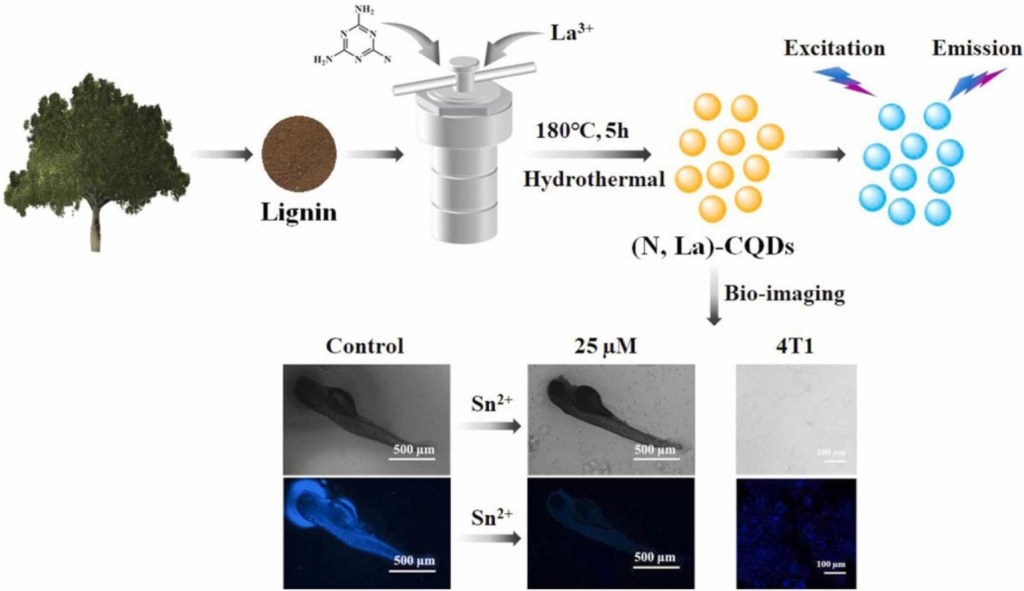
Owing to their versatility, fluorescent carbon quantum dots (CQDs) have attracted significant attention for applications in sensors, bioimaging, microfluidics, photodynamic therapy, drug delivery, light-emitting diode, etc. Herein, nitrogen and lanthanum co-doped multifunctional lignin-based carbon quantum dots ((N, La)-CQDs) were prepared from enzymatic hydrolysis lignin using a simple one-step hydrothermal method. The diameter of the CQDs obtained was about 2.2 nm with a good water solubility at the excitation wavelength of around 365 nm and emission wavelength of around 465 nm. This is the first discovery of (N, La)-CQDs to detect Sn2+. (N, La)-CQDs were successfully used to detect Fe3+, Sn2+, and ClO ions in the range of 0–100 μM with the detection limits of 0.99 μM, 1.1 μM and 1.1 μM sequentially, and the linear fit R2 of 0.9997, 0.9943 and 0.9941 respectively. Non-cytotoxic (N, La)-CQDs can be used for labeling cells and detecting Sn2+ in zebrafish. These attractive features make these non-toxic, environmentally friendly CQDs material highly promising for applications in a wide range of areas, such as biomedicine, biosensing, disease diagnosis, and environmental monitoring.

New Article: Low-temperature torrefaction assisted with solid-state KOH/urea pretreatment for accelerated methane production in wheat straw anaerobic digestion

A new article out of a collaboration between Dr. Ning Yan and Dr. Heyu Chen’s labs has been published in Bioresource Technology Journal written by Zhijiang Shao, Pitchaimari Gnanasekar, Nicole Tratnik, Nicolas R. Tanguy, Xiaohui Guo, Mingqiang Zhu, Ling Qiu, Ning Yan, and Heyu Chen.

You can find the article here.

Abstract

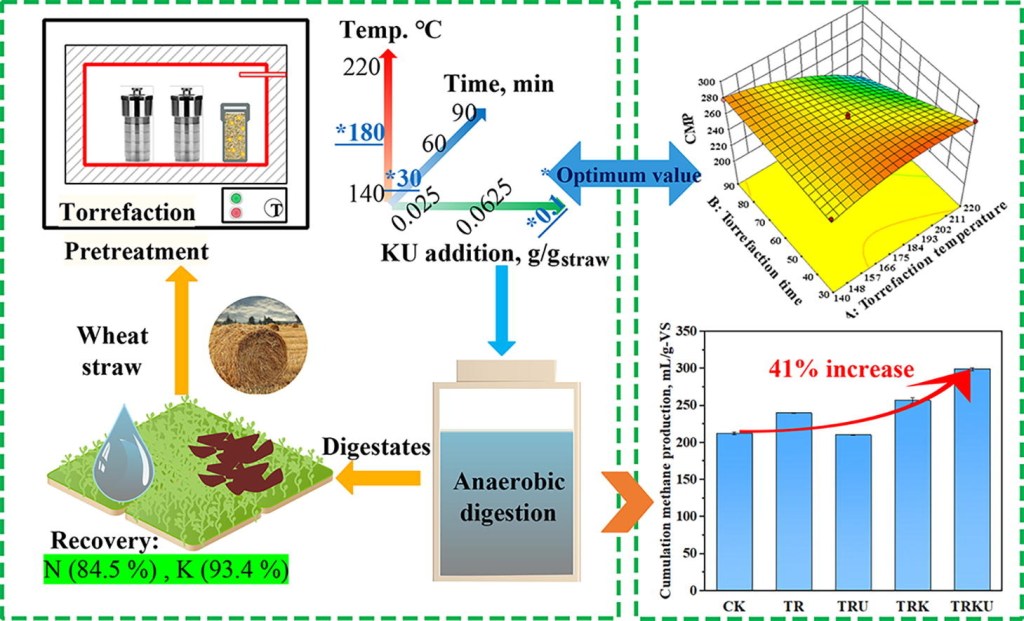
Low-temperature torrefaction assisted with solid-state KOH/urea applied onto wheat straw was proposed to break down the lignocellulosic material to enhance biomethane production in anaerobic digestion (AD). The optimization of key parameters applying the Box-Behnken design and response surface method showed that an addition of 0.1 g/gstraw KOH/urea at 180 ℃ while torrefying for 30 min was the optimal condition for producing biomethane. Results indicate that co-applying KOH and urea in torrefaction synergistically enhanced the biodegradability of straw by effectively removing lignin and largely retaining cellulose, giving rise to a 41 % increase in the cumulative methane production compared to untreated straw (213 mL/g-volatile solids (VSraw)) from batch AD. Additionally, the nitrogen- and potassium-rich digestates helped to improve soil fertility, thus achieving a zero-waste discharge. This study demonstrated the feasibility of using solid-state KOH/urea assisted low-temperature torrefaction as an effective pretreatment method to promote methane production during AD.

New Article: Multifunctional superhydrophilic/underwater superoleophobic lignin-based polyurethane foam for highly efficient oil-water separation and water purification

A new article out of a collaboration between Dr. Ning Yan and Dr. Jing Chen’s labs has been published in Separation and Purification Technology Journal written by Jing Chen, Jialong Wu, Yinyan Zhong, Xiaozhen Ma, Wanrong Lv, Honglong Zhao, Jin Zhu, and Ning Yan.

You can find the article here.

Abstract

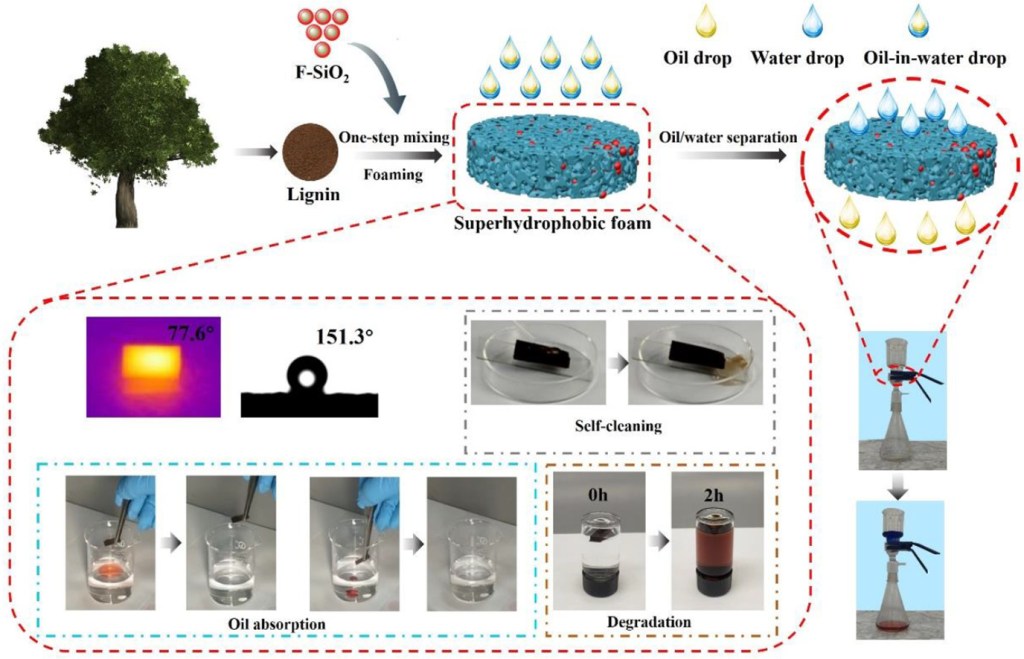
Superwettability can affect the performance of oil separation from water during the treatment of oily wastewater. Among various types of materials developed for cleaning oil pollution, foam is a popular choice due to its attractive lightweight properties and adjustable porosities. Foams with superwetting surfaces (superhydrophilic/superoleophobic underwater) are ideal for oil/water separations. In this study, lignin-based polyurethane foams (LPUFs) were synthesized first, and then polydopamine particles were deposited on the surface of the foam by in situ polymerization under weak alkaline conditions to increase its surface roughness. Afterwards, phytic acid was used to modify the foam to achieve surface superhydrophilicity and underwater superoleophobicity. Successful loading of polydopamine (PDA) particles and coating of phytic acid (PA) onto the foam was demonstrated by SEM, EDS, FTIR, XPS, and thermogravimetric analysis measurements. It was shown in the cyclic compression tests that LPUFs had good mechanical properties. Under 75 % compression strain, the maximum stress in the first cycle of LPUF/PDA/PA was 105.92 kPa. After 30 cyclic compression tests, the maximum stress of LPUF/PDA/PA under 75 % compression strain was 105.63 kPa, demonstrating a high mechanical stability. The contact angle of the foam modified by PDA and PA was 0° for water, 166.7° for chloroform, and 158.4° for hexane, which also demonstrated excellent underwater anti-oil adhesion performances. Oil-water separation tests by using PDA and PA modified lignin-based foam with mixtures of water and n-hexane, cyclohexane, toluene, and pump oil indicated a separation efficiency of over 99 % for the types of mixtures tested together with excellent repeatability. In addition, the PDA and PA modified lignin-based foams were able to adsorb 67.1 mg/g of methylene blue, 96.1 mg/g of rhodamine B, and 98.2 mg/g of copper sulfate. The lignin-based foam could completely degrade under weak alkaline conditions after usage. This study highlighted a novel strategy for synthesizing environmentally friendly high-performance adsorbents to efficiently treat polluted wastewater using lignin as a raw material.