Join Prof. Ning Yan’s Lab at the University of Toronto. We’re seeking a highly motivated Postdoctoral Researcher to work on developing functional bio-based polymers. This 1-year appointment can be extended. Start immediately.
Requirements:
Ph.D. in Polymer Chemistry, Materials Science, or related field
Strong background in polymer chemistry and materials characterization
Experience in biopolymer/material synthesis and modification, polymer/composite processing, and material characterization is highly desirable
Excellent communication and interpersonal skills
To apply, please email your CV and research statement to Prof. Ning Yan at ning.yan@utoronto.ca. Please note that only candidates selected for an interview will be contacted.
A new article out of a collaboration between Dr. Ning Yan and Dr. Jing Chen’s labs has been published in Small written by Xiaozhen Ma, Xiaolin Wang, Honglong Zhao, Xiaobo Xu, Minghui Cui, Nathan E. Stott, Peng Chen, Jin Zhu, Ning Yan, and Jing Chen.
In this work, high-performance, light-stimulation healable, and closed-loop recyclable covalent adaptable networks are successfully synthesized from natural lignin-based polyurethane (LPU) Zn2+ coordination structures (LPUxZy). Using an optimized LPU (LPU-20 with a tensile strength of 28.4 ± 3.5 MPa) as the matrix for Zn2+ coordination, LPUs with covalent adaptable coordination networks are obtained that have different amounts of Zn. When the feed amount of ZnCl2 is 9 wt%, the strength of LPU-20Z9 reaches 37.3 ± 3.1 MPa with a toughness of 175.4 ± 4.6 MJ m−3, which is 1.7 times of that of LPU-20. In addition, Zn2+ has a crucial catalytic effect on “dissociation mechanism” in the exchange reaction of LPU. Moreover, the Zn2+-based coordination bonds significantly enhance the photothermal conversion capability of lignin. The maximum surface temperature of LPU-20Z9 reaches 118 °C under the near-infrared illumination of 0.8 W m−2. This allows the LPU-20Z9 to self-heal within 10 min. Due to the catalytic effect of Zn2+, LPU-20Z9 can be degraded and recovered in ethanol completely. Through the investigation of the mechanisms for exchange reaction and the design of the closed-loop recycling method, this work is expected to provide insight into the development of novel LPUs with high-performance, light-stimulated heal ability, and closed-loop recyclability; which can be applied toward the expanded development of intelligent elastomers.
Congratulations Prof. Ning Yan on being elected a new Fellow for 2023!
The Canadian Academy of Engineering is the national institution through which individuals, who have made outstanding contributions to engineering in Canada, provide strategic advice on matters of critical importance to Canada and to Canadians. The CAE is an independent, self-governing, and non-profit organization established in 1987. Fellows of the CAE are nominated and elected by their peers, in view of their distinguished achievements and career-long service. Fellows of the Canadian Academy of Engineering are committed to ensuring that Canada’s engineering expertise and experience are applied to the benefit of all Canadians.
The Canadian Academy of Engineering works in close cooperation with other senior academies in Canada and internationally. The CAE is a founding member of the Council of Canadian Academies (CCA), and a member of the International Council of Academies of Engineering and Technological Sciences (CAETS), which includes 31 national engineering academies around the world. The CAE is also a member of the Partnership Group for Science and Engineering (PAGSE), an association of more than 20 Canadian organizations in science and engineering, whose mandate is to educate and inform federal Parliamentarians, decision makers and other leaders of the importance and significance of Canadian research and innovation to economic development, and society as a whole.
“The election of these exceptional faculty and alumni to the Academy is an important recognition of their impact as engineering innovators, educators and leaders, both nationally and globally,” says U of T Engineering Dean Christopher Yip. “On behalf of the Faculty, congratulations to all our new CAE fellows.”
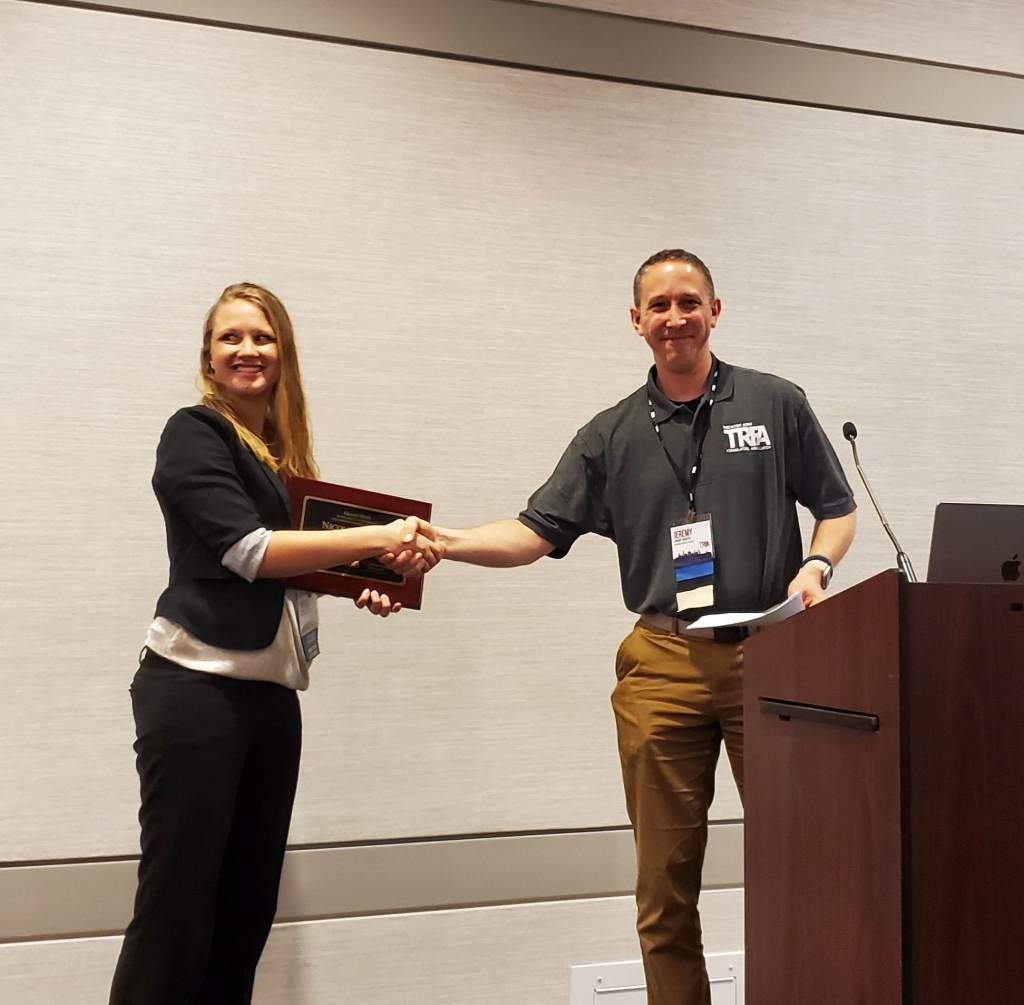
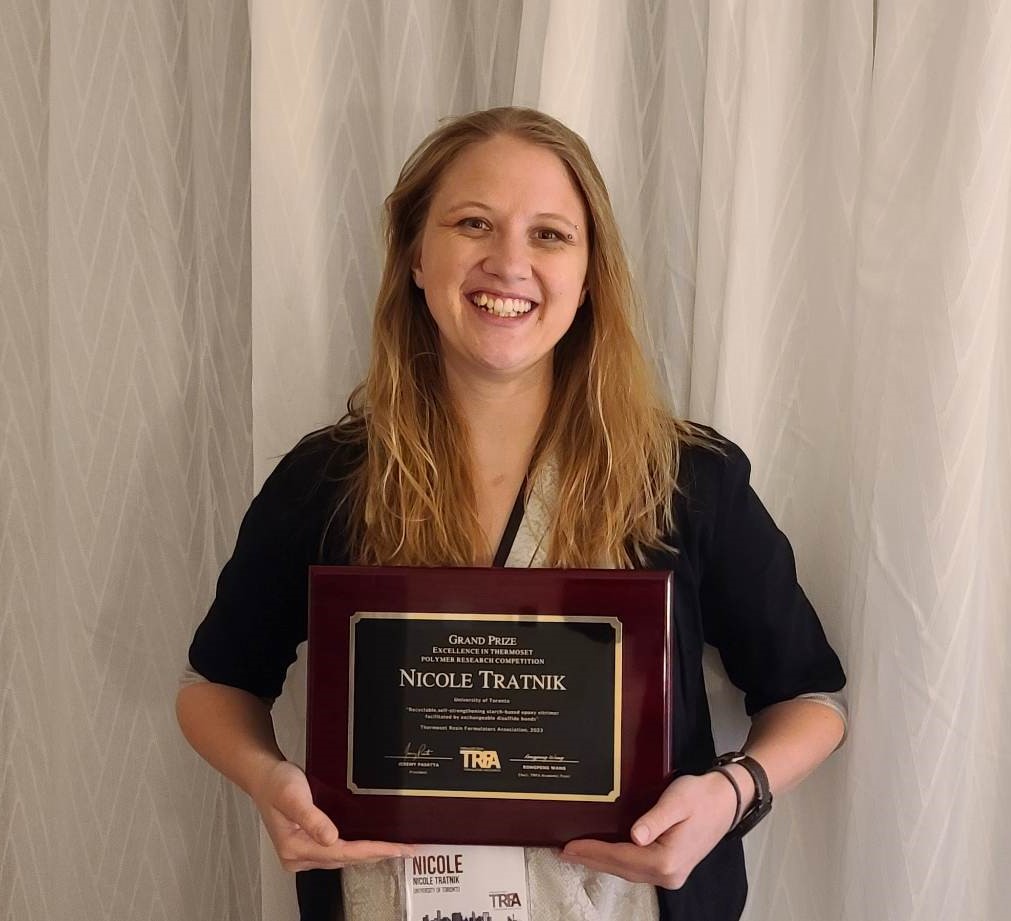
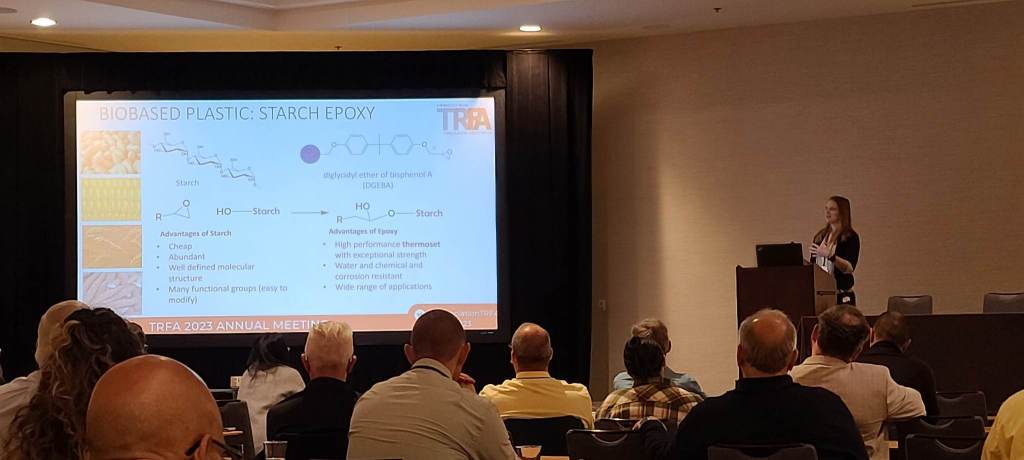
Ph.D. Candidate Nicole Tratnik won first prize in the Excellence in Thermoset Polymers Research Competition hosted by the Thermoset Resin Formulators Association for her paper titled “Recyclable, self-strengthening starch-based epoxy vitrimer facilitated by exchangeable disulfide bonds”. She was flown out to Denver, CO to present her work at the TRFA Annual Meeting with over 120 attendees. Her award-winning paper can be found here.
Congratulations Nicole!
You can read more about the news on the UofT Chem Eng website here.
A new article from Ning Yan’s lab has been published in Chemical Engineering Journal written by Nicolas R. Tanguy, Maryam Moradpour, Mandeep C. Jain, Ning Yan, and Mohammad H. Zarifi.
The article can be accessed for free until June 13, 2023 by clicking here.
The rapid development of electronics has caused the accumulation of electronic waste that is threatening the environment and human health. The deployment of the Internet of Things (IoT), enabled by 5G microwave communication technology, will involve an increasing number of electronic devices. Microwave communication devices consist of petroleum/ceramic-based substrates and metallic traces that are non-biodegradable. Here, we report a smart, flexible, and transient organic microwave resonator (TOMR) using cellulose nanofibrils (CNF) nanopaper as substrate and poly(3,4-ethylenedioxythiophene):polystyrene sulfonate (PEDOT:PSS) as conducting trace. The device produced a resonant profile with the maximum transmission coefficient (S21) amplitude of −14.95 dB at a resonant frequency of 2.75 GHz under ambient conditions (20 °C, 30% relative humidity (RH)). The TOMR demonstrated sensing capabilities, wherein increasing the %RH modulated the device’s resonant amplitude (-29 mdB/%RH from 0% to 50% RH and −90 mdB/%RH from 50% to 90% RH) and resonant frequency (3600 kHz/%RH). Moreover, the PEDOT:PSS trace could be reclaimed, recycled, and redeposited on a CNF nanopaper, which enabled the fabrication of a TOMR that displayed a similar resonant profile. Hence, this study demonstrates the first transient organic microwave resonator embedded with sensing capabilities and introduces a framework to minimize the environmental impact of 5G microwave communication devices for the IoT.
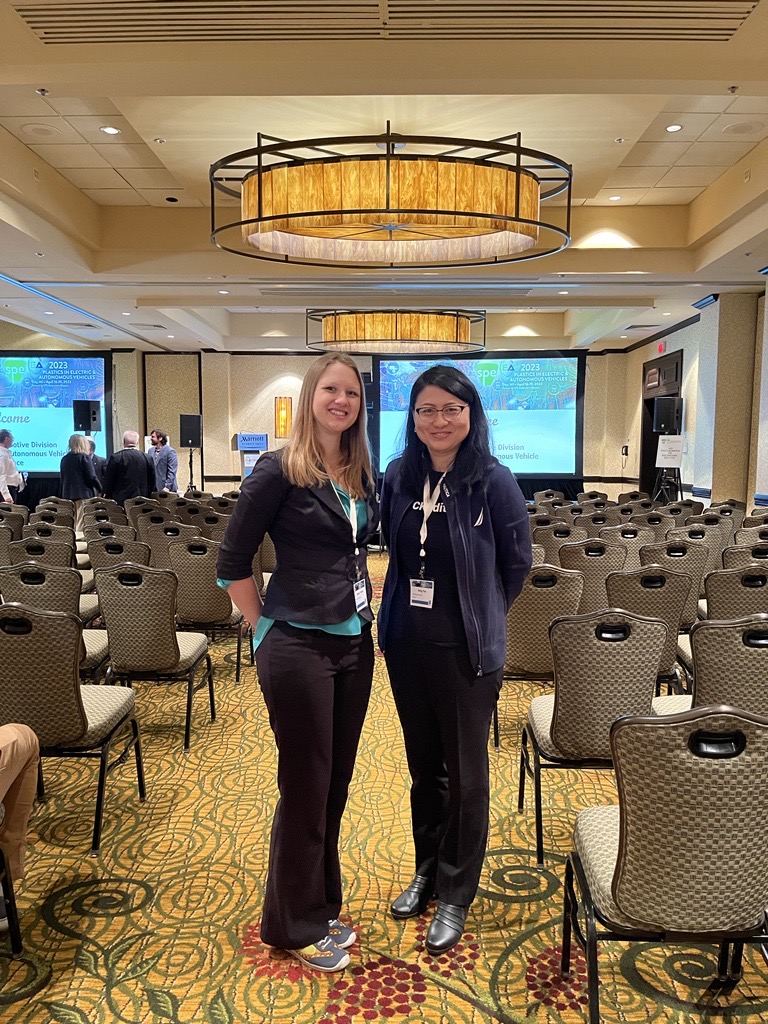
We are happy to announce our Ph.D Candidate, Nicole Tratnik, won 5th place in the student poster competition at the SPE,EAV Plastics in Electric & Autonomous Vehicles Conference. Her poster was titled, “Enhanced sustainability of upcycleable biobased epoxy vitrimers with designed recyclability” and was based off of her recently published paper that can be found here. Congrats Nicole!
A new article from Ning Yan’s lab has been published in Industrial Crops and Products written by Chuanwei Zhang, Pengfei Zhang, Yanhui Li, S. Nair Sandeep, Jianyong Li, Maocheng Ji, Sixian Peng, Ning Yan, and Fangyi Li.
Through a single-sided cavity free-form foaming process, composites with open cell structures similar to wood cells were obtained by using corn starch, pulp fiber, and sisal fibers, which was used as the middle layer of the sandwiched composites. Afterwards, more hydrophobic lignin-containing nanocellulose fibrils from pine bark were coated on the surfaces of the open cell composites by high-pressure gun spraying, simulating the bark of wood to impart barrier property to the final product. The water barrier, mechanical property, apparent density, heat insulation, and biodegradability of the sandwich structured bio-composites were characterized. Experimental results indicated that the water contact angle on the surface of the bio-composite was as high as 92°. The apparent density of the bio-composite was very low, at 0.107 g/cm3. The tensile strength of the bio-composites reached 5.3 MPa. After conducting biodegradability tests in soil for 60 days, the bio-composites lost 87 % of its mass.
A new article out of a collaboration between Dr. Ning Yan and Dr. Jing Chen’s labs has been published in the Journal of Environmental Chemical Engineering written by Xiaojun Zhang, Jialong Wu, Manxiang Wu, Lianfu Wang, Dayu Yu, Ning Yan, Huiming Wu, Jin Zhu, and Jing Chen.
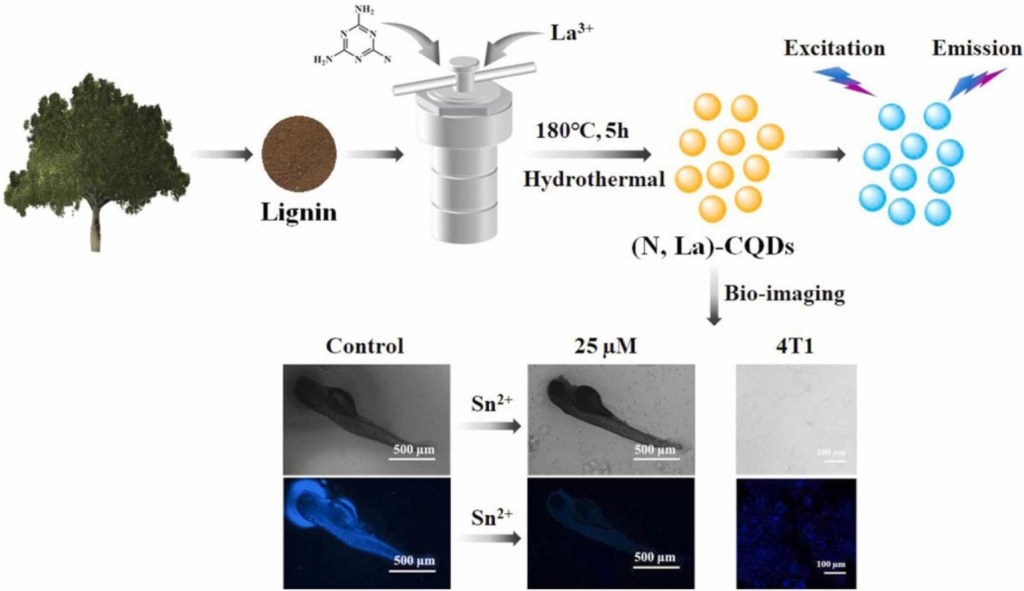
Owing to their versatility, fluorescent carbon quantum dots (CQDs) have attracted significant attention for applications in sensors, bioimaging, microfluidics, photodynamic therapy, drug delivery, light-emitting diode, etc. Herein, nitrogen and lanthanum co-doped multifunctional lignin-based carbon quantum dots ((N, La)-CQDs) were prepared from enzymatic hydrolysis lignin using a simple one-step hydrothermal method. The diameter of the CQDs obtained was about 2.2 nm with a good water solubility at the excitation wavelength of around 365 nm and emission wavelength of around 465 nm. This is the first discovery of (N, La)-CQDs to detect Sn2+. (N, La)-CQDs were successfully used to detect Fe3+, Sn2+, and ClO– ions in the range of 0–100 μM with the detection limits of 0.99 μM, 1.1 μM and 1.1 μM sequentially, and the linear fit R2 of 0.9997, 0.9943 and 0.9941 respectively. Non-cytotoxic (N, La)-CQDs can be used for labeling cells and detecting Sn2+ in zebrafish. These attractive features make these non-toxic, environmentally friendly CQDs material highly promising for applications in a wide range of areas, such as biomedicine, biosensing, disease diagnosis, and environmental monitoring.
A new article out of a collaboration between Dr. Ning Yan and Dr. Heyu Chen’s labs has been published in Bioresource Technology Journal written by Zhijiang Shao, Pitchaimari Gnanasekar, Nicole Tratnik, Nicolas R. Tanguy, Xiaohui Guo, Mingqiang Zhu, Ling Qiu, Ning Yan, and Heyu Chen.
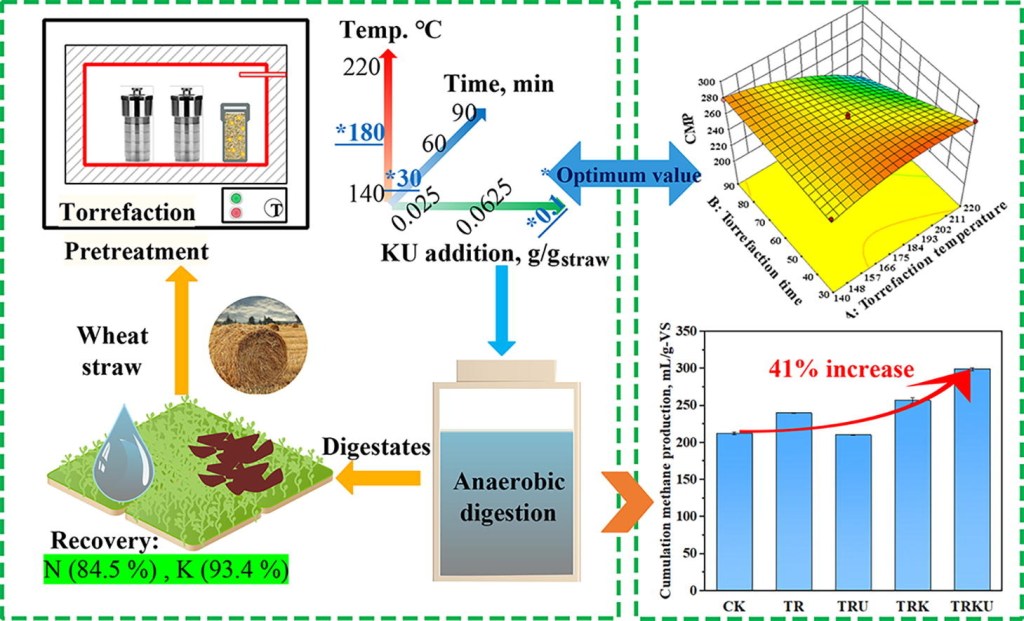
Low-temperature torrefaction assisted with solid-state KOH/urea applied onto wheat straw was proposed to break down the lignocellulosic material to enhance biomethane production in anaerobic digestion (AD). The optimization of key parameters applying the Box-Behnken design and response surface method showed that an addition of 0.1 g/gstraw KOH/urea at 180 ℃ while torrefying for 30 min was the optimal condition for producing biomethane. Results indicate that co-applying KOH and urea in torrefaction synergistically enhanced the biodegradability of straw by effectively removing lignin and largely retaining cellulose, giving rise to a 41 % increase in the cumulative methane production compared to untreated straw (213 mL/g-volatile solids (VSraw)) from batch AD. Additionally, the nitrogen- and potassium-rich digestates helped to improve soil fertility, thus achieving a zero-waste discharge. This study demonstrated the feasibility of using solid-state KOH/urea assisted low-temperature torrefaction as an effective pretreatment method to promote methane production during AD.
Join WISE on Wednesday, March 8th from 6 – 10 pm at our annual International Women’s Day Gala!
This formal event commemorates the incredible achievements of women everywhere with the promise of great conversations, inspirational speakers, a stunning performance, and a delicious dinner. Tickets for the event can be purchased here: https://www.eventbrite.ca/e/537116027497. Early bird tickets are currently on sale, get them while they last!