Congratulations on Professor Yan winning Macromolecular Science and Engineering Award!

This distinguished honor is presented to an individual residing in Canada who has made an outstanding contribution to the advancement of macromolecular science or engineering. Professor Yan’s innovative research, leadership, and dedication to the field exemplify the spirit of this award and highlight the remarkable impact of their work on both the scientific community and the next generation of researchers. Our group is proud to celebrate this well‑deserved recognition.
Link to page: Macromolecular Science and Engineering Award

NEW ARTICLE: Lignin-derived PFAS- and halogen-free flame retardant with robust thermal stability for PC/ABS blends

A new article from Ning Yan’s lab has been published in the Chemical Engineering Journal written by Cheng Hao, Daniel Davidson, Haonan Zhang, Alper Alper, Shawn Prevoir and Ning Yan.

You can find the article here.

Abstract

The flammability of polycarbonate/acrylonitrile butadiene styrene (PC/ABS) significantly restricts its use in safety-critical applications, despite its desirable mechanical and thermal properties. Bio-based, halogen- and PFAS-free flame retardants have gained interest as sustainable alternatives to conventional halogen-based flame retardants for engineering thermoplastics, yet most exhibit insufficient thermal stability for the demanding processing temperatures (>250 °C) required by high melting point engineering thermoplastics, such as PC/ABS. To overcome this fundamental thermal stability bottleneck, in this study, a reactive compatibilization strategy was developed to tailor a thermally robust and compatibilized lignin-derived flame-retardant system for PC/ABS. Nitrogen and phosphorous modified lignin was pre-compounded with styrene-maleic anhydride copolymer (SMA), which not only significantly raised the onset decomposition temperature (Td5 = 293 °C) to withstand the high-temperature compounding, but also ensured uniform dispersion within PC/ABS. This strategy enabled, to the best of our knowledge, for the first time, effective incorporation of a bio-based flame retardant into engineering-grade PC/ABS at industrial relevant loadings. With the addition of 5 wt% LNP and 10 wt% SMA, the PC/ABS blends achieved the UL-94 V-0 rating with an increased limited oxygen index (LOI) and a 51.5 % reduction in peak heat release rate, while significantly enhancing heat deflection temperature and maintaining tensile strength of the PC/ABS samples. Mechanistic investigations revealed a synergistic condensed-phase barrier effect from crosslinked phosphorus-rich char and a gas-phase radical-quenching effect to suppress flame propagation. This work aligns with current regulatory drivers to replace halogenated and PFAS-based additives, showing a viable pathway for developing sustainable and high-performance flame retardants for engineering thermoplastics with high melting temperatures.

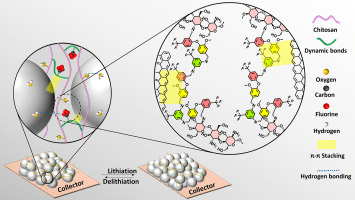
NEW ARTICLE: Self-healable chitosan-based polymer binder for anode in lithium-ion batteries

A new article from Ning Yan’s lab has been published in the Chemical Engineering Journal written by Mohammad H. Mahaninia, Keerti Rathi, Ning Yan, Mohini Sain, Colin van der Kuur.

You can find the article here.

Abstract

To enhance the performance and durability of lithium-ion batteries, the development of effective binder materials in the anode is crucial, with eco-friendliness being an additional consideration. This study presents a bio-based and self-healable polymeric binder designed for use in graphite-based anodes to achieve enhanced battery performance. The binder was synthesized via a Schiff base reaction between chitosan and a vanillin-derived linker, forming imine bonds that establish a self-healable 3D network. The bio-based binder effectively holds the graphite particles together while also providing excellent mechanical strength, thermal stability, and strong adhesion to the copper foil. Notably, it demonstrated self-healing behavior, with mechanical recovery exceeding 90 % after damage. Thermogravimetric analysis confirmed high thermal stability up to 300 °C, while the binder exhibited excellent tensile adhesion strength (ca. 21 kPa). Both coin and pouch cells fabricated with the bio-based binder achieved a specific capacity of 161.2 mAh g−1 and retained 81 % of their capacity after 250 cycles. Coulombic efficiency remained consistent at above 92 % even after 250 cycles, indicating no side reactions. Even at a high current density of 1.0C, the cells maintained approximately 50 % of their original capacity measured at 0.3C, showcasing excellent rate capability. Electrochemical impedance spectroscopy revealed low interfacial resistance, further validating the stability of the chitosan-based binder. We anticipate that this class of bio-based binders will not only extend the service life of lithium-ion batteries but also make a significant contribution to greener, safer energy storage technologies.