Last week, a member of Prof. Ning Yan’s Lab, Gaojian Guo, successfully passed his qualifying exam signifying she is able to continue with his PhD studies. In the next few years he will continue his work on studies in the high-value utilization of lignin and its functional applications.
Last week, a member of Prof. Ning Yan’s Lab, Lavia Li, successfully passed her qualifying exam signifying she is able to continue with her PhD studies. In the next few years she will continue her work on the studies on engineering strategies of graphite in next generation battery.
A new article from Ning Yan’s lab has been published in the Carbohydrate Polymers written by Sanming Hu, Zhijun Shi, Kun Chen, Xiao Chen, Hongfu Zhou, Ning Yan, Guang Yang,
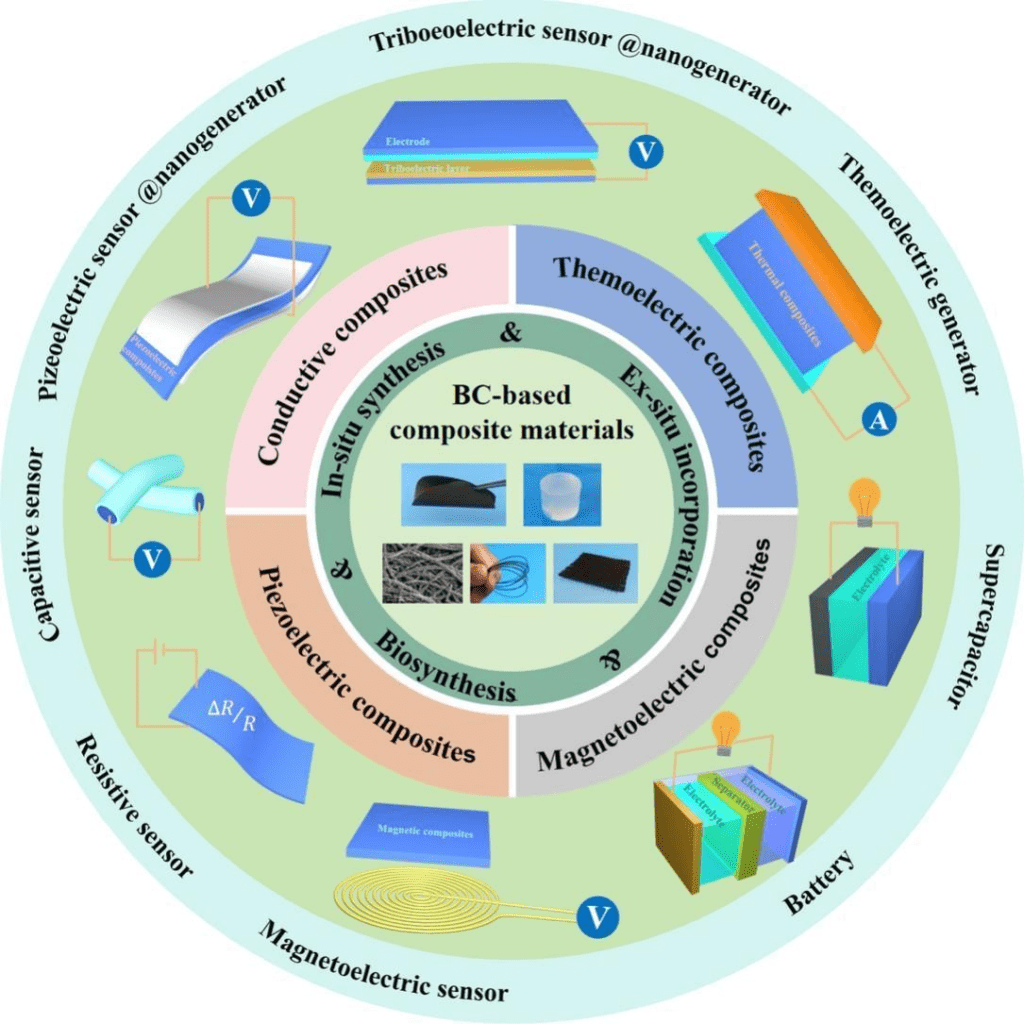
The proliferation of electronic devices has led to a substantial increase in non-degradable electronic waste (e-waste), posing significant environmental challenges. Consequently, biodegradable natural polymers have garnered considerable attention as sustainable alternatives to conventional non-degradable materials in electronic applications. Bacterial cellulose (BC), a natural polymer characterized by abundant hydroxyl groups and a three-dimensional (3D) nanonetwork structure, exhibits exceptional properties including high purity, superior mechanical strength, excellent water retention capacity, non-toxicity, renewability, and complete biodegradability. These unique attributes, coupled with its distinctive structural features, render BC as a promising green matrix material for developing functional composites in eco-friendly electronic devices. This review provides a systematic analysis of various eco-friendly composite materials derived from BC, covering conductive, piezoelectric, magnetoelectric, and thermoelectric composites. Additionally, the fabrication methodologies for BC-based composites, including in-situ chemical synthesis, ex-situ incorporation, and biosynthesis techniques, are comprehensively analyzed. Furthermore, the applications of BC-based composites was explored in diverse fields such as sensors, energy storage systems (batteries and supercapacitors), and energy harvesting devices (nanogenerators). Finally, we deliver a critical evaluation of the current challenges and future research directions for BC-based composites in the development of sustainable electronic devices.
A new article from Ning Yan’s lab has been published in the Journal of Materials Chemistry A written by Keerti Rathi, Viktoriya Pakharenko, Otavio Augusto Titton Dias, Colin van der Kuur, Ning Yan and Mohini Sain
Our research demonstrates a one-step dual-process acid treatment approach for modifying graphite, which increases its interlayer distance and generates nanoscale holes, thereby effectively shortening the lithium-ion diffusion pathway without the need for heteroatom doping. Compared with pristine graphite (PG), the expanded holey graphite (EG) produced by this process achieves significantly enhanced electrochemical performance while maintaining structural integrity. The EG shows excellent electrochemical performance, reaching a specific capacity of 179.45 mAh g−1 and retaining 89.3% of its capacity after 300 cycles in a full pouch cell combined with a commercial NMC523 cathode. High coulombic efficiency (approximately 93.8%) and improved cycling stability confirm the durability of the etched graphite. Beyond mere performance considerations, the study elucidates the degradation mechanisms inherent in commercial lithium-ion batteries (LIBs), thereby offering dependable guidance for electrode surface engineering and the optimization of cycling protocols. With this scalable and impurity-free approach to modification, purified etched graphite emerges as a promising candidate for next-generation LIB anodes, satisfying the high energy requirements and durability necessary for electric vehicles and advanced energy storage systems.



 Yan Lab