New article: Chitosan-based partial Vitrimer for making eco-friendly multifunctional ramie fabric reinforced composite

A new article from Ning Yan’s lab has been published in International Journal of Biological Macromolecules written by Mohammad H. Mahaninia and Ning Yan.

You can find the article for free here until June 03, 2025.
Abstract

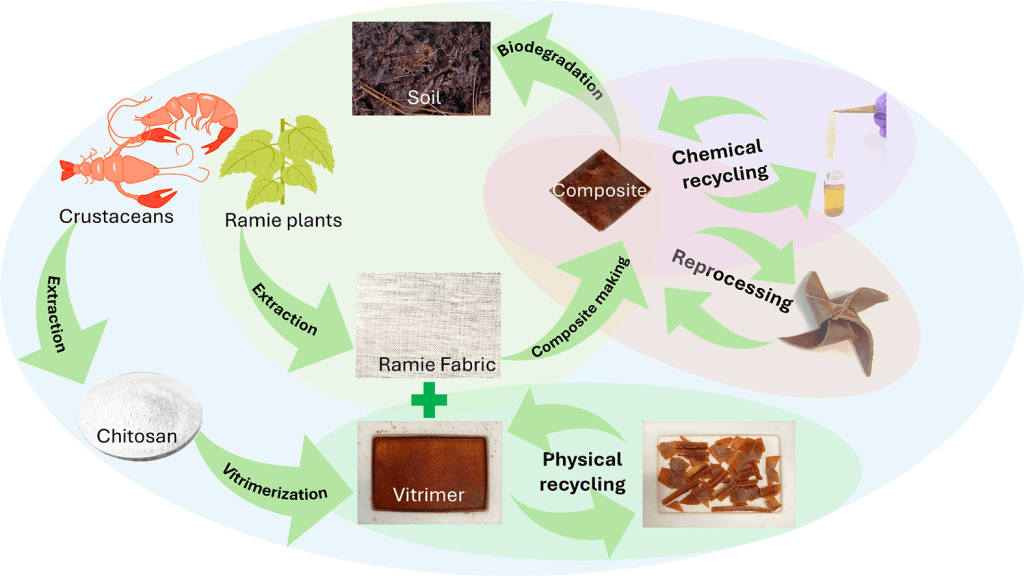
In this study, a novel chitosan-based partial vitrimer was synthesized and used as the matrix material to fabricate eco-friendly fully bio-based polymer composites reinforced with ramie fabric. The chitosan-based partial vitrimers were prepared by a facile and green chemistry method without the use of catalyst. It contained amide bonds that could undergo transamidation bond exchange reactions autocatalyzed by the nearby functional groups. Using this partial vitrimer, a recyclable/biodegradable biocomposite reinforced with 40 wt% of ramie fabric was fabricated by using the hot-pressing method. The biocomposite showed excellent mechanical properties (e.g., tensile strength of 124 MPa) compared to other chitosan-based natural fiber composites reported in the literature. Benefiting from the self-healing, shape memory, and reprocessibility of the chitosan-based vitrimeric matrix, the resulting ramie fabric biocomposite also exhibited remoldability, shape memory, and self-adhesive properties. The ramie fabric composite was fully biodegraded in 12 weeks while the vitrimeric matrix alone biodegraded only in 2 weeks. These findings highlight the potential of chitosan-based partial vitrimer in developing high-performance, multifunctional, and sustainable biocomposites for various applications.
New article: Integrated emulsion separation and fog collection with functionalized Janus wood membrane for water scarcity solutions

A new article from Ning Yan’s lab has been published in npj Clean Water written by Kaiwen Chen, Jianyi Zhu, Cheng Hao, Haonan Zhang, Yujing Tan, Xianfu Xiao, Fengze Sun, Xuewen Han, Hui Peng, Tianyi Zhan, Jianxiong Lyu & Ning Yan.

You can find the article here.

Abstract

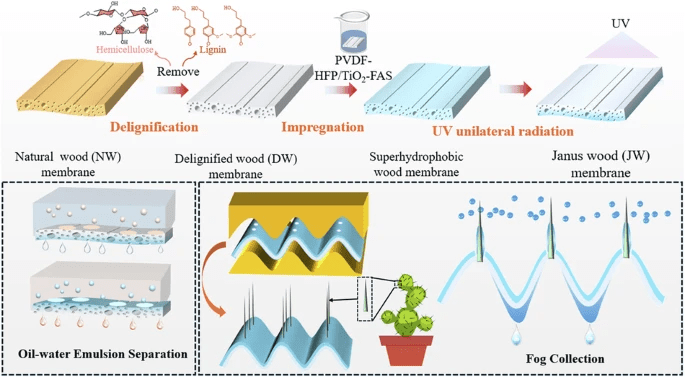
Global climate change has exacerbated water scarcity, while traditional water treatment technologies are often unsustainable due to high energy consumption and negative environmental impacts, posing an urgent need for a sustainable solution. This study developed a novel wood-based flexible Janus membrane coupled with a spine structure for efficient oil-water emulsion separation and fog harvesting. The Janus wood membrane showed high separation efficiency (> 99.6%), high filtration flux (water-in-oil and oil-in-water emulsions exceeded 810 L/m²·h and 747 L/m²·h, respectively), and good reusability. Additionally, the introduction of spine and conical pores significantly enhanced fog collection efficiency (19.23 kg/m²·h), expanding the application potential of Janus membranes. Moreover, this Janus wood membrane offered excellent mechanical properties, dimensional stability, mildew resistance, and environmental benefits. This study underscored the potential of Janus membranes in water management and liquid separation, providing a sustainable solution to water scarcity.