On December 10th a member of Prof. Ning Yan’s Lab, Troy Su, successfully passed his qualifying exam signifying he is able to continue with his PhD studies. In the next few years he will continue his work on lignocellulose-reinforced bio-composites.
A new article out of a collaboration with Amirjalal Jalali from Dr. Mohini Sain and Dr. Chul B Park’s labs has been published in Nano Energy written by Amirjalal Jalali, Araz Rajabi-Abhari, Haonan Zhang, Tanmay Gupta, Otavio Augusto Titton Dias, Md Akibul Islam, Tobin Filleter, Ning Yan, Mohini Sain, and Chul B Park.
A free copy of the article can be found here until January 31, 2025.
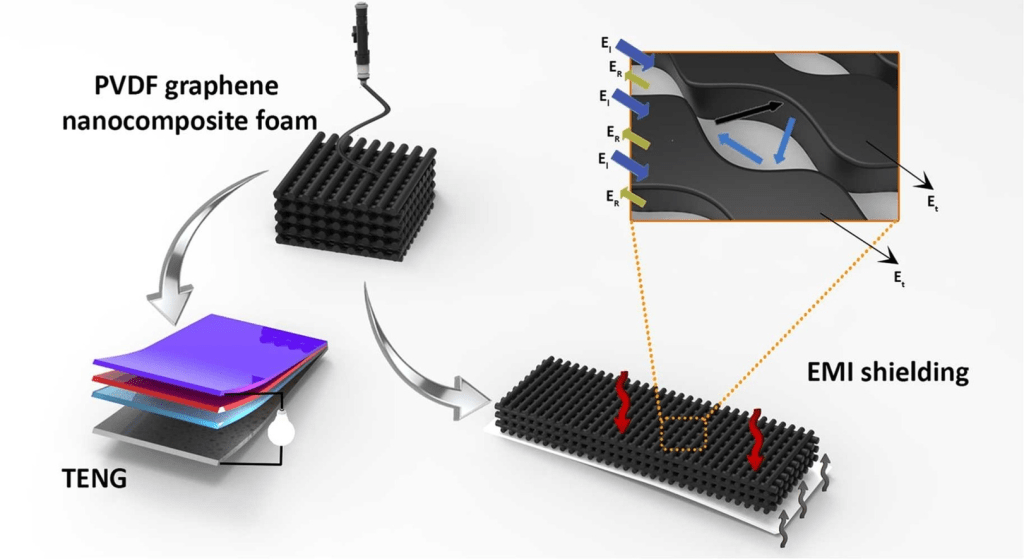
This study explores the novel realm of foam 3D-printing, a convergence of foaming and 3D-printing techniques, with profound implications for multifunctional stretchable electronics. Through scalable in situ foam printing, lightweight and stretchable foamed polyvinylidene fluoride (PVDF)/graphene nanocomposites were successfully fabricated. By incorporating varying percentages (2, 3, 5, and 7 wt%) of graphene into PVDF, alongside a 3 wt% foaming agent for foamed 3D-printing filaments, a diverse range of filaments were fabricated. Next, employing fused filament fabrication (FFF), 3D-printed PVDF nanocomposites and nanocomposites foams were produced. Both shear and elongational rheological tests, respectively, corroborated that the incorporation of a foaming agent and graphene amplified the shear-thinning behavior and instigated strain hardening in the PVDF nanocomposite foam, rendering them viable options for foam 3D-printing. The resulting materials exhibited promising electrical and thermal conductivity attributes, as well as effective electromagnetic interference (EMI) shielding properties. The additional nanofiller content significantly augmented both electrical and thermal conductivity, further enhanced by the introduction of a cellular structure. Notably, foamed 3D-printed PVDF nanocomposites containing 7 wt% of graphene demonstrated an EMI shielding effectiveness (SE) of 36 dB distinguished by minimal reflectivity and predominant absorption characteristics. X-ray diffraction (XRD) analysis indicated that the in situ foam 3D-printing facilitates the formation of the β-phase. The printed specimens were deployed as the tribonegative element in the Triboelectric Nanogenerator (TENG) system. The fabricated TENG displayed notable efficiency, as evidenced by the foamed 3D-printed PVDF, which generated an output voltage of 270 V and a current of 5 μA, successfully illuminating 80 Light Emitting Diode (LED) lights. Meanwhile, the 3D-printed nanocomposite foams with 3 wt% nanofiller exhibited superior performance, achieving an output voltage of 550 V and a current of 11 μA. This investigation underscores the potential of the in situ foam 3D-printing for the development of advanced lightweight and flexible energy storage devices.


 Yan Lab