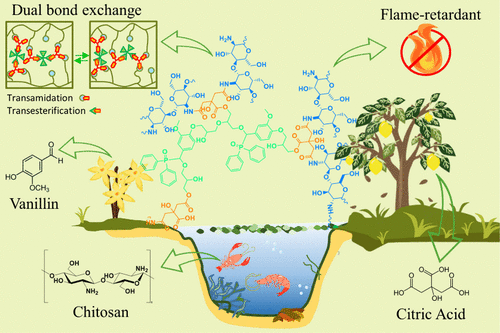
The front cover art for the manuscript: “Catalyst-Free Biodegradable Chitosan-Based Dual Dynamic Covalent Networks with Self-Healing and Flame-Retardant Properties” by Mohammad Mahaninia and Ning Yan has been published in ACS Sustainable Chemistry & Engineering.
A new article from Ning Yan’s lab has been published in Macromolecular Rapid Communications written by Nicolas R. Tanguy, Araz Rajabi-Abhari, Eric Williams-Linera, Zheyuan Miao, Nicole Tratnik, Xiao Zhang, Cheng Hao, Alvin Virya, Ning Yan, and Ronan Le Lagadec.
Wearable strain transducers are poised to transform the field of healthcare owing to the promise of personalized devices capable of real-time collection of human physiological health indicators. For instance, monitoring patients’ progress following injury and/or surgery during physiotherapy is crucial but rarely performed outside clinics. Herein, multifunctional liquid-free ionic elastomers are designed through the volume effect and the formation of dynamic hydrogen bond networks between polyvinyl alcohol (PVA) and weak acids (phosphoric acid, phytic acid, formic acid, citric acid). An ultra-stretchable (4600% strain), highly conducting (10 mS cm-1), self-repairable (77% of initial strain), and adhesive ionic elastomer is obtained at high loadings of phytic acid (4:1 weight to PVA). Moreover, the elastomer displayed durable performances, with intact mechanical properties after a year of storage. The elastomer is used as a transducer to monitor human motions in a device comprising an ESP32-based development board. The device detected walking and/or running biomechanics and communicated motion-sensing data (i.e., amplitude, frequency) wirelessly. The reported technology can also be applied to other body parts to monitor recovery after injury and/or surgery and inform practitioners of motion biomechanics remotely and in real time to increase convalescence effectiveness, reduce clinic appointments, and prevent injuries.



 Yan Lab