
A new article from Ning Yan’s lab has been published in Composites Part B: Engineering written by Qin Chen, Haonan Zhang, Cheng Hao, Limin Guo, Long Bai, Jiyou Gu, and Ning Yan. You can find the article here.
Click here to see the full article until April 03, 2024
Abstract
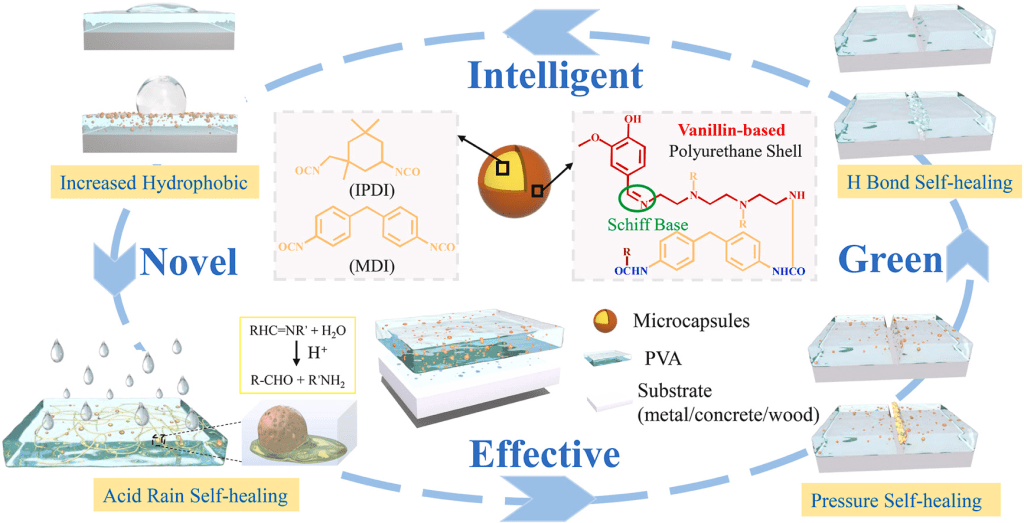
Self-healing technology based on microcapsules (MCs) holds great promise for preventing material performance deterioration, extending material lifespan, and reducing maintenance costs. In this study, a novel pH-responsive MC with a vanillin-based Schiff base polyurea shell and an isocyanate core was successfully prepared using interfacial polymerization. Vanillin-based Schiff base-containing triamines were synthesized, and their existence was confirmed through ATR-FTIR and 1H NMR analyses. The core-shell structures of the MCs were identified using FTIR and TGA. Additionally, the excellent response of the MCs to acid rain was demonstrated by determining the core content and recording optical images of the healing agent release process, with the fastest release rate observed at a pH of 2.98. According to the FTIR and TGA results, the release of the healing agent was continuous rather than occurring once. The MCs were incorporated into outdoor building materials (OBMs) (carbon steel, concrete, and wood) as a coating in conjunction with paint or polyvinyl alcohol (PVA). The pressure response, hydrogen bonding response, and hydrophobicity of the composite coating were assessed using SEM and water contact angle measurements. After subjecting the materials to 50 cycles of acid rain wet-dry tests (pH = 5.03), the carbon steel remained largely rust-free, whereas untreated carbon steel could only withstand a single cycle. Consequently, this study highlights a novel green structure and scalable manufacturing process for functional self-healing MCs, with significant implications for the advancement of stimulus-responsive composite materials and the realization of a sustainable and environmentally friendly economy.

 Yan Lab