
A new article from Ning Yan’s lab has been published in the Advanced Functional Materials written by Kaiwen Chen, Cheng Hao, Wenjuan Zhao, Haonan Zhang, Jianxiong Lyu and Ning Yan.
You can find the article here.
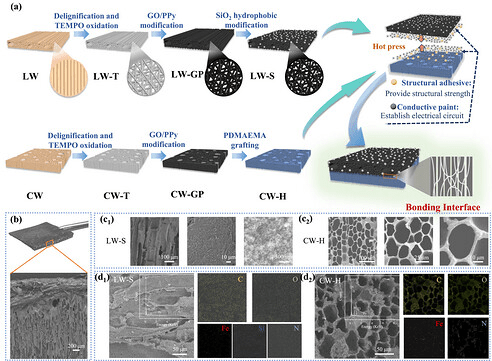
Abstract
Efficient and intelligent membranes that can overcome the inherent trade-off between flux and selectivity while providing real-time process monitoring are highly desirable for advanced oil/water separation. This work reported a smart conductive Janus wood membrane (CJW) that integrated high-efficiency oil/water separation with in situ real-time monitoring. A bio-inspired modular design strategy fully exploited wood’s natural anisotropy: transverse wood with vertically aligned macrochannels acted as a high-flux transport layer, while longitudinal wood with an inherent micro/nano-capillary network served as a high-precision sieving layer. Asymmetric wettability was established by grafting hydrophilic poly(DMAEMA) on one side and immobilizing hydrophobic fluorosilane-modified nano-SiO2 on the other side. A continuous GO/PPy conductive network distributed throughout the hierarchical pores enabled in situ electrical sensing during separation. The resulting membrane achieved separation efficiencies > 93.1% over 30 cycles for immiscible oil/water mixtures, with a maximum flux of 8001 L/m2·h. For oil/water emulsions, efficiencies remained > 92.3% after 10 cycles with sustained fluxes of 540-760 L/m2·h. The electrical response of the conductive network provided real-time feedback on membrane status. Additionally, a threshold-based early-warning mechanism using the coefficient of variation (CV) of resistance predicted degradation 3-18 cycles in advance. This work presents a novel paradigm for intelligent separation materials with self-monitoring capabilities.

