
A new article from Ning Yan’s lab has been published in the Chemical Engineering Journal written by Mohammad H. Mahaninia, Keerti Rathi, Ning Yan, Mohini Sain, Colin van der Kuur.
You can find the article here.
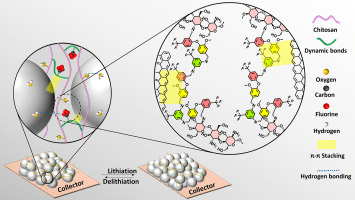
Abstract
To enhance the performance and durability of lithium-ion batteries, the development of effective binder materials in the anode is crucial, with eco-friendliness being an additional consideration. This study presents a bio-based and self-healable polymeric binder designed for use in graphite-based anodes to achieve enhanced battery performance. The binder was synthesized via a Schiff base reaction between chitosan and a vanillin-derived linker, forming imine bonds that establish a self-healable 3D network. The bio-based binder effectively holds the graphite particles together while also providing excellent mechanical strength, thermal stability, and strong adhesion to the copper foil. Notably, it demonstrated self-healing behavior, with mechanical recovery exceeding 90 % after damage. Thermogravimetric analysis confirmed high thermal stability up to 300 °C, while the binder exhibited excellent tensile adhesion strength (ca. 21 kPa). Both coin and pouch cells fabricated with the bio-based binder achieved a specific capacity of 161.2 mAh g−1 and retained 81 % of their capacity after 250 cycles. Coulombic efficiency remained consistent at above 92 % even after 250 cycles, indicating no side reactions. Even at a high current density of 1.0C, the cells maintained approximately 50 % of their original capacity measured at 0.3C, showcasing excellent rate capability. Electrochemical impedance spectroscopy revealed low interfacial resistance, further validating the stability of the chitosan-based binder. We anticipate that this class of bio-based binders will not only extend the service life of lithium-ion batteries but also make a significant contribution to greener, safer energy storage technologies.
 Yan Lab