
A new article from Ning Yan’s lab has been published in the Advanced Functional Materials written by Qin Chen, Araz Rajabi-Abhari, Tongtong Fu, Haonan Zhang, Siqi Huan, Liang Chen, Jinchao Li, Cheng Hao, Yaping Zhang and Ning Yan
You can find the paper here.
Abstract
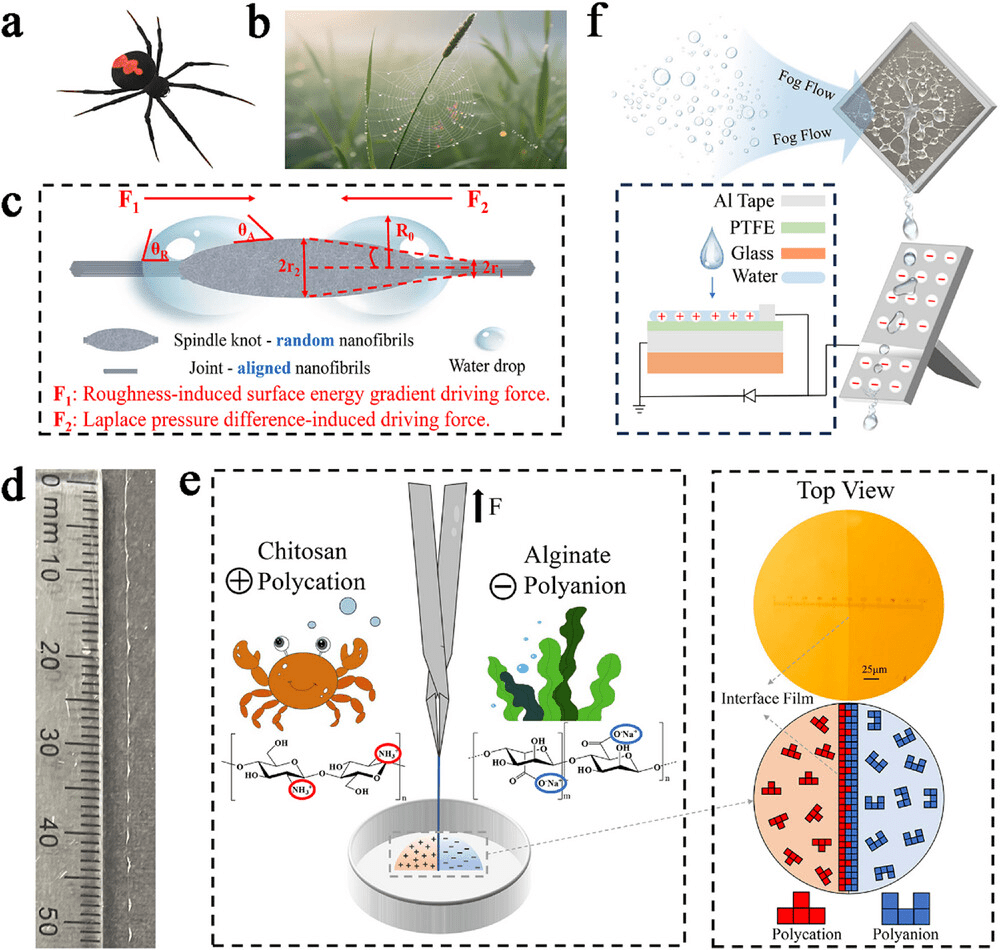
Atmospheric water harvesting has emerged as a sustainable solution for overcoming water and energy shortages. Herein, an entirely biobased bionic spider silk (chitosan–sodium alginate filament [CSF]) is prepared using an interfacial, aqueous, and straightforward polyelectrolyte complexation with a continuous drawing technique, simultaneously harvesting water and triboelectric energy from ambient humidity. CSF exhibits a periodic spindle-shaped structure resembling spider silk, with surface roughness conducive to atmospheric water harvesting. The success of the electrostatic complexation technique for CSF is confirmed by water solubility, Fourier-transform infrared spectroscopy, and thermogravimetric analyses. The production yield of CSF reaches the maximum of 99.36% by controlling the substrate type and polyelectrolyte mass ratio. Moreover, fog-harvesting efficiency peaks at 1552.83 mg cm−1 h−1 (1.0 wt.% polyelectrolyte concentration), demonstrating concentration-dependent performance. Subsequently, CSF is woven into a bionic spider web (CSW) for simultaneous water and energy harvesting. Through parametric optimization, the CSW-based droplet triboelectric nanogenerator system achieves 180 V and 72.25 µW output. When deployed in a high-humidity greenhouse, the system powers 80 light-emitting diodes, a hygrometer (thermometer), and a stopwatch. This study presents a straightforward, effective, and green strategy for simultaneously harvesting water and energy from the ambient environment, providing fresh water and renewable energy to enhance sustainability.
 Yan Lab