
A new article from Ning Yan’s lab has been published in Chemical Engineering Journal written by Haonan Zhang, Yanchen Zhu, Tongtong Fu, Cheng Hao, Yang Huang, Hao Ren, Ning Yan, Huamin Zhai. You can find the article HERE.
Click here to see the full article until April 25, 2024
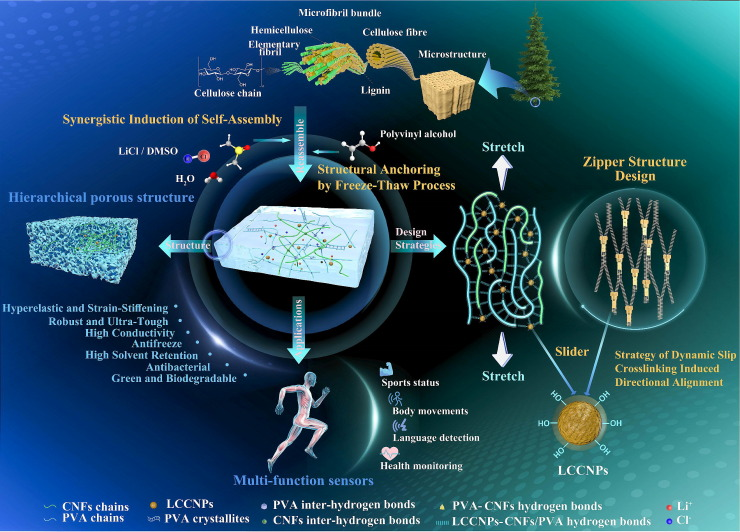
Abstract
Soft electronics have garnered significant interests owing to their distinctive qualities. However, their practical utilizations are still limited by their generally poor mechanical properties, environmental concerns, and incompatibility. Here, we present a unique hierarchical nanoarchitectural design of dynamic noncovalent supramolecular zipper to achieve synergistic enhancement of both mechanical strength and toughness in organogels. By building lignin-carbohydrate complexes nanoparticles (LCCNPs)-based sliding zippers within the interpenetrating polymer networks (IPN) formed by in-situ regenerated cellulose nanofibrils (CNFs) and polyvinyl alcohol (PVA) molecular chains, the lignocellulosic organogels demonstrated excellent mechanical properties, shape recovery performances, and strain-stiffening behaviors. The ultimate tensile strength increased by 11-fold, reaching 8.29 MPa, while the toughness also had an increase of 24-fold, reaching 23.8 MJ/m3 at the same time, comparing to those of the PVA hydrogel. These novel organogels also exhibited exceptional anti-freezing (<-150 °C), anti-dehydration, transparency, UV-shielding, and biodegradable properties. The assembled wearable sensor using the organogels were able to monitor human motion status and physiological signals with a tunable conductivity (up to 5.14 S/m), a high sensitivity (a maximum gauge factor of 5.62) and long cyclic stability (2000 cycles). This novel nano-structural design approach showcases a facile and versatile platform for constructing the next-generation high performance bio-based soft electronics.
 Yan Lab