
A new article from Ning Yan’s lab has been published in International Journal of Biological Macromolecules written by Mohammad H. Mahaninia, Zhuoya Wang, Araz Rajabi-Abhari, and Ning Yan.
You can find this article HERE.
Abstract
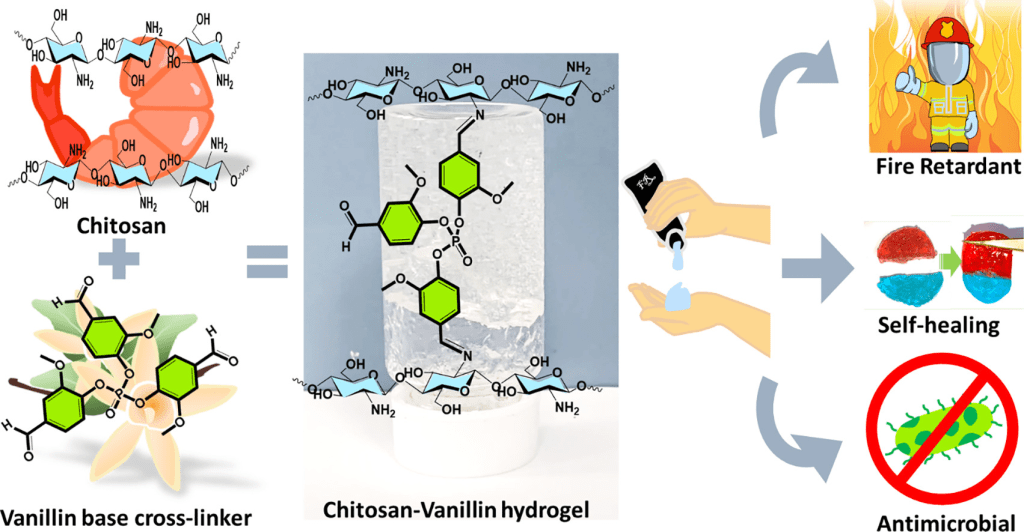
This study reports the fabrication of chitosan-based hydrogels with potential to be applied as a flame-retardant coating on skin or other surfaces. These hydrogels possess remarkable antimicrobial properties that are highly desirable for the protection of epidermises. Hydrogels in this study were prepared via the cross-linking reaction of chitosan with a vanillin-based cross linker containing flame-retarding moieties through Schiff’s base reaction. The synthesized hydrogels possess imine linkages enabling them to self-heal at room temperature. Self-healing abilities offered these hydrogels the ability to protect the skin for a longer time. One flame retarding mechanism of these hydrogels was by retaining the water in their polymeric network; thus, the role of bound and unbound water molecules was studied using DSC and Raman spectroscopy. The hydrogels synthesized in this study retained their flame-retarding properties even after drying due to the charring process that inhibited the pyrolysis process. Therefore, these chitosan-based hydrogels are able to prolong the protection time against fire.
 Yan Lab